


 Add:No. 16 Xingye Road, Beijiao Town Industrial Park, Shunde District, Foshan City, Guangdong Province
 PHONE: +86 13509957538
 TEL: +86 0757-26131933
 Email: huayin_glass@163.com

Chinese


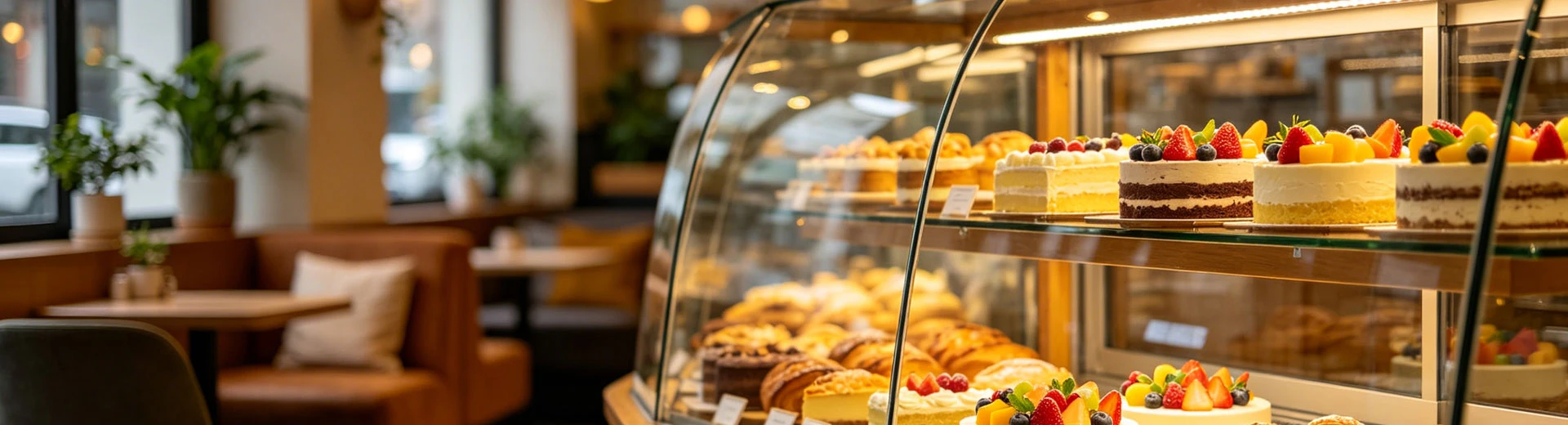
Hot bent laminated glass is the only construction that delivers three properties at once on a curved lite: the optical continuity of a bent surface, the post-breakage safety of a laminated structure, and a laminating film that can carry coatings or heating layers where the application demands them. Curved pastry display cases, wine cooler arcs, flower cold room fronts and curved sliding doors all sit on this construction. This whitepaper defines how forming and laminating interact, where the interlayer decision changes the product, and which tests a buyer should specify before release of production tooling.
Hot bent laminated glass is produced by bending each glass ply over a mould at 600–640°C, then laminating two bent plies with an interlayer under heat and pressure. The critical constraint is that both plies must share the same radius within tight tolerance: a mismatch of more than 0.5 mm across the chord leaves the interlayer stretched on one side and wrinkled on the other, which becomes a visible distortion line and a long-term delamination site.
Bending before laminating is the industrial standard; laminating first and then re-bending is limited to very large radii because the interlayer softens and allows ply slip. When a buyer receives a quote for hot bent laminated glass, the radius tolerance of each ply — not the assembly — is the parameter that determines whether the project runs cleanly.
The interlayer is a structural decision, not a film choice. Three systems cover the commercial range, and each behaves differently on curved geometries.
| Interlayer | Strength profile | Best fit on bent lites |
|---|---|---|
| PVB 0.38 / 0.76 mm | Standard safety performance, high optical clarity, proven autoclave process | Default choice for display cases and cabinet fronts |
| SGP (ionoplast) 0.89 mm | About 5× the stiffness of PVB, minimal post-breakage sag | Load-bearing curved panels, doors with hardware fixed into glass |
| EVA 0.38 / 0.76 mm | Laminates without autoclave, tolerant of humidity during cure | Small batches, deep curves, lites combined with fabric or film inserts |
On curved lites the interlayer also has to accept curvature without thinning. PVB stretches on the convex side and compresses on the concave side, so ply radius matching matters more with 0.76 mm than 0.38 mm. EVA cures at lower pressure and tolerates small ply mismatch, which is why it survives on deep curves where autoclave routing is uneconomic.
Every thickness has a practical minimum radius below which the quenched surface develops optical distortion and residual stress concentrations at the curvature apex.
| Ply thickness | Practical min. radius | Typical sag tolerance |
|---|---|---|
| 3.2 mm | ≥ 200 mm | ±0.5 mm on template |
| 4 mm | ≥ 300 mm | ±0.5 mm on template |
| 5 mm | ≥ 450 mm | ±1.0 mm on template |
| 6 mm | ≥ 600 mm | ±1.0 mm on template |
Below these radii the bending furnace produces roll waves concentrated at the apex, and the tempered ply holds a stress profile that no longer matches a flat laminate's certifiable behaviour. Where the design demands a tighter radius, the answer is thinner plies in the laminate — two 4 mm plies instead of one 6 mm — not forcing the bend.
Three control points decide the yield of a bent laminate run. First, mould accuracy: a single set of matched moulds per radius, checked against a certified template each shift, prevents the ply mismatch described in section 1. Second, autoclave parameters: PVB laminates run at roughly 135–145°C and 10–14 bar for 30–60 minutes; insufficient wet-out shows as small bubbles at the curvature apex where the interlayer bridges a gap. Third, edge quality: the laminate edge is where moisture enters, so edges must be ground after lamination with no exposed, chipped interlayer.
Optical distortion is measured with a zebra board held behind the curved lite while viewing a straight reference line. Walk wave and roll wave limits should be written into the drawing — "distortion to EN 572-8 class" is a phrase a buyer can enforce at incoming inspection.
A two-ply laminate with a 0.76 mm PVB interlayer carries EN 12600 class 1B1: the glass may crack under impact, but the interlayer holds the fragments and the opening stays covered. For export orders the acceptance test is the impact classification itself, witnessed per batch with the laminate retained as a limit sample. Each tempered ply should also meet its own fragmentation requirement before laminating, because a ply that fails fragmentation compromises the whole laminate's class.
Buyers in North America reference ANSI Z97.1 drop-ball behaviour; the construction is the same, but the certification path differs, so the target standard must be fixed at order stage, not at shipment.
Four application families dominate demand. Curved pastry and deli cases use 2×4 mm PVB laminates where the arc is a merchandising surface. Wine cooler and cellar fronts combine hot bent glass aesthetics with laminated safety at low heights. Flower cold room fronts and curved sliding doors specify laminated construction where glass sits above head height, and where a single 6 mm ply would be both heavy and non-compliant. Curved door lites that also need heating use bent ITO-coated plies laminated into the assembly — the coating sits on surface 2 or 3, protected from wiping, with busbars routed at the vertical edges.
Where insulation is required, a bent laminate can be combined into an insulated glass unit with a curved spacer; this heated insulated curved assembly is the standard construction for outdoor-facing or high-humidity curved display fronts.
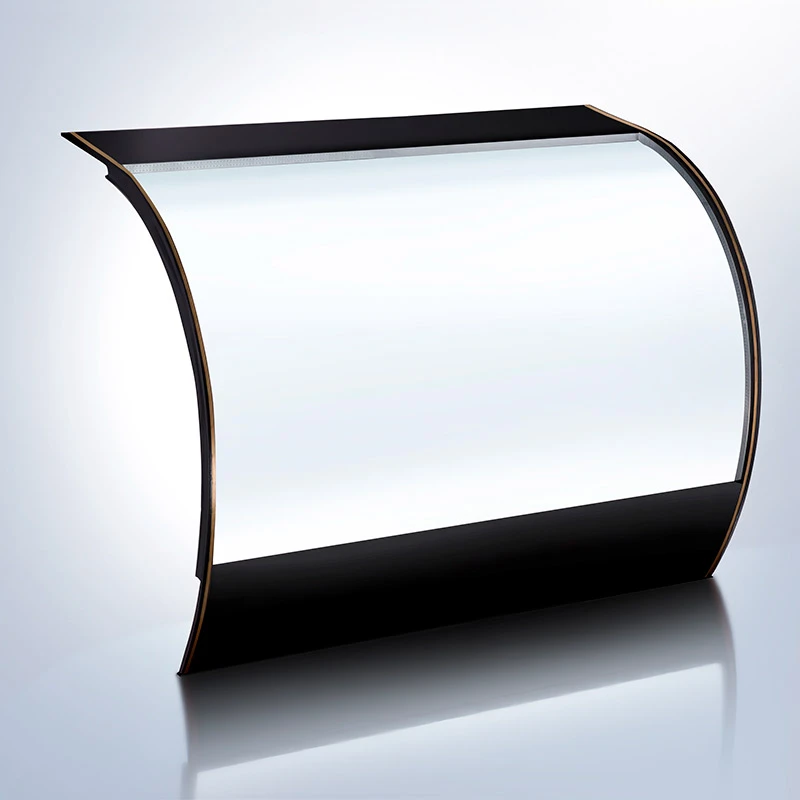
Five checks at incoming inspection cover the failure modes that matter. Template fit: hold each lite to the certified radius template and measure gap, ±0.5 mm for 4 mm plies. Interlayer certificate: batch number of PVB/SGP/EVA recorded against the glass batch. Delamination resistance: boil test on a retained coupon, 2 hours in water, no bubble growth beyond 2 mm at edges. Edge quality: no exposed or chipped interlayer, ground edge finish on all sides. Distortion: zebra board viewing, walk wave within the written class. A supplier who resists any of these five has told the buyer something.
| Term | Definition |
|---|---|
| Interlayer | The polymer sheet (PVB, SGP or EVA) bonded between glass plies to give post-breakage integrity |
| Sag | The depth of the curved surface measured from the chord; the key dimensional on a bent lite |
| Autoclave | Pressure vessel that bonds glass and interlayer under heat and pressure |
| Ply mismatch | Radius difference between the two glass plies; causes interlayer wrinkling and visible distortion |
| Roll wave | Periodic surface distortion from bending or tempering, visible as a moving ripple against a straight line |
| EN 12600 1B1 | Impact classification: glass breaks but stays held by the interlayer with no opening |
Huayin Glass Solutions has processed bent and laminated glass since 2002 from a 6,000+ m² plant in Foshan, Guangdong, with forced-convection flat and curved tempering furnaces, a waterjet cutting centre and full lamination capability for export orders to 50+ countries. Send your radius drawing to our engineering team for a bendability assessment and sample plan, or review our manufacturing capability first.
Further reading: Hot Bent Laminated Glass · Curved Tempered Glass · Refrigerator Glass Doors · Client Cases · ITO Glass vs Defogging Coating
Add:No. 16 Xingye Road, Beijiao Town Industrial Park, Shunde District, Foshan City, Guangdong Province
PHONE: +86 13509957538
TEL: +86 0757-26131933
Email: huayin_glass@163.com

© 2026 Huayin Glass Solutions All Rights Reserved.


