


 Add:No. 16 Xingye Road, Beijiao Town Industrial Park, Shunde District, Foshan City, Guangdong Province
 PHONE: +86 13509957538
 TEL: +86 0757-26131933
 Email: huayin_glass@163.com

Chinese


A custom logo glass door turns a cabinet into brand media: the logo sits inside the retail environment for years, backlit or edge-lit, seen by every shopper who walks past. That is exactly why logo doors fail loudly — a mis-registered brand colour or a peeled print is visible from metres away. The failures concentrate in six decisions made before tooling. This checklist converts each one into something you can verify with the supplier before the deposit.
The single most common restart cause in logo door projects is artwork arriving as a low-resolution bitmap or a screenshot. Screen printing needs vector files; colours need references, not "brand blue". The specification that works: vector artwork with clear space defined, Pantone or equivalent references for each colour, and the minimum logo size stated against the door size. With those three items a factory can quote a screen count and a tooling cost in the first reply instead of a guess.
The two routes differ in one physical fact: fired ceramic ink is sintered into the glass surface during tempering and becomes part of it; applied films and UV-cured prints sit on top and wear with condensation, cleaning and cold. Freezer doors run through thousands of defrost-wipe cycles, so the process choice is effectively a durability choice.
| Criterion | Fired-in screen print | Applied film / UV print |
|---|---|---|
| Process | Printed before tempering, sintered into surface | Applied after tempering onto the surface |
| Durability | Survives wiping, condensation and cleaning fluids | Degrades with moisture and abrasion over time |
| Colour accuracy | Good, with screen tooling per colour | Good for short runs and gradients |
| Tooling | Screens per colour, upfront tooling cost | Low tooling, higher per-unit variability |
| Best fit | Production volumes, long-life doors | Prototypes, campaigns, short series |
For branded beer cooler doors and chain-store freezer programmes, fired-in printing is the default; applied decoration belongs at prototype and pilot stages.
"Match the sample" is not a colour specification. Working practice: approve one physical reference panel per colour, then hold production batches to a stated colour difference (ΔE) against that reference under a defined illuminant. Doors in a run sit side by side in the same aisle — a batch drift that looks small on a single panel becomes obvious across a row of cabinets. The same clause covers registration: logo position tolerance set against the door frame reveal, because the shopper's eye aligns the logo with the frame, not with the glass edge.
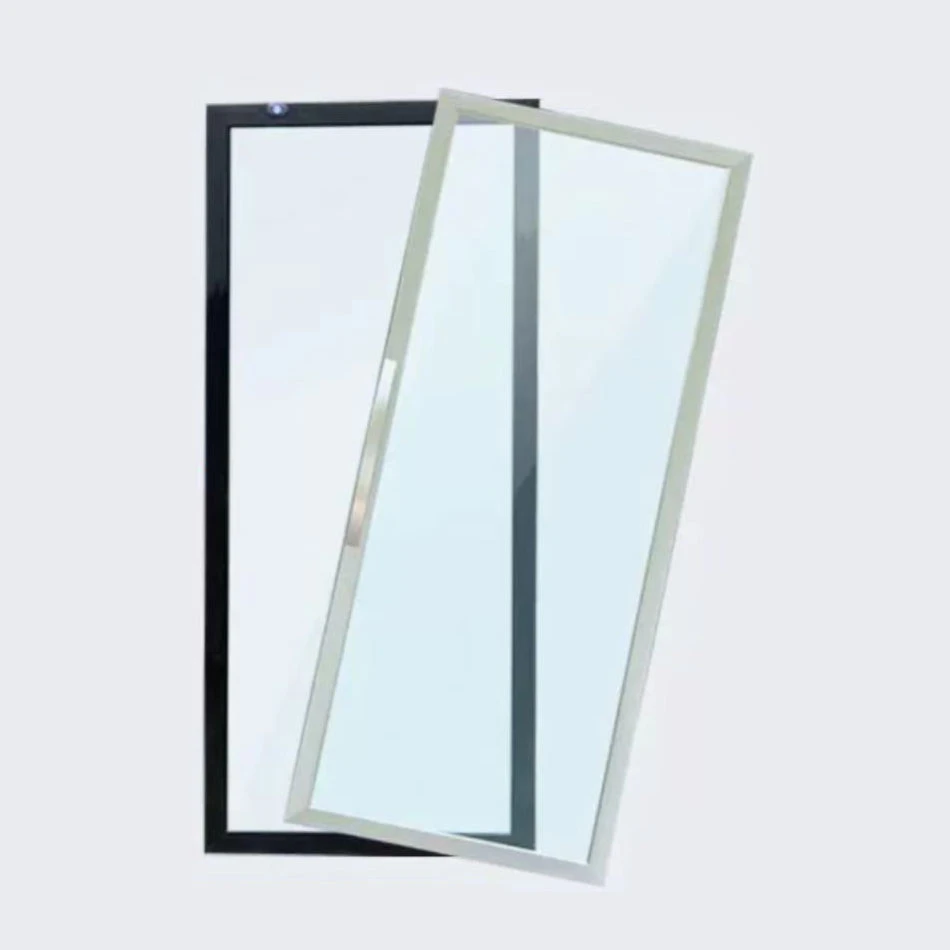
Logo doors usually carry lighting: perimeter LED strips, ambient light in the corners, or flashing light accents on the logo itself. The print layer and the lighting layer interact — diffusion layers behind the glass soften lamp dots but also soften printed edges; light strips positioned against the logo without a diffusion window create hot spots that wash the brand mark out. Co-design means the print layout, diffusion zones and strip positions are decided on the same drawing. Products such as the custom logo door with automatic side lights and the rounded-corner printed door with perimeter LED exist precisely because the two layers were engineered together.
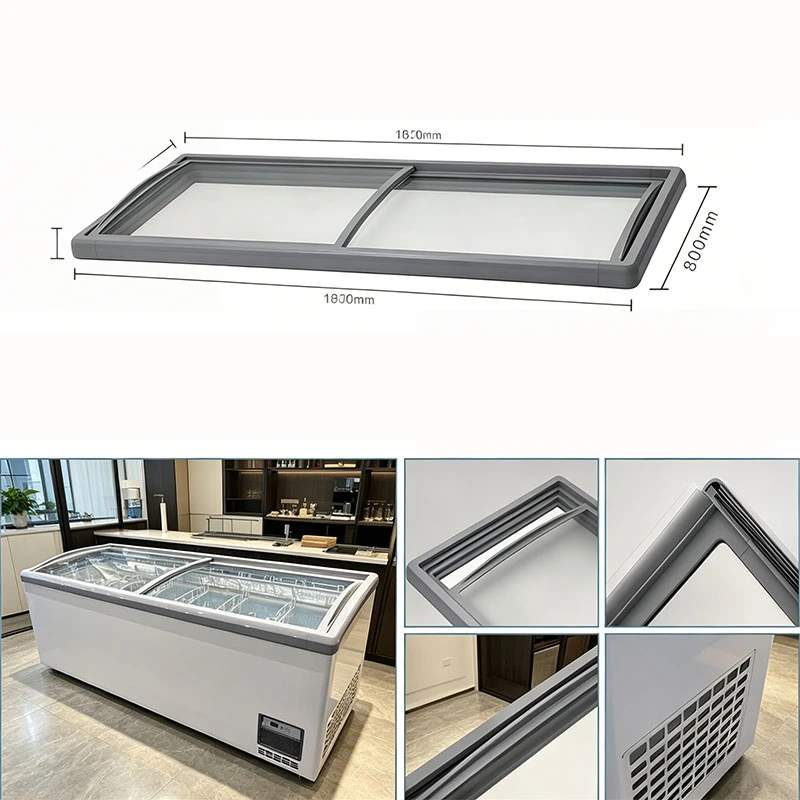
Screen tooling is charged per colour, which is why logo door MOQ sits higher than plain doors. The verifiable terms: tooling cost and ownership (who holds the screens), MOQ per SKU, and batch records — colour difference and registration per lot. A supplier who produces refrigerator glass doors at volume will hand over these records routinely; one who cannot has outsourced the printing, and your brand consistency is now two tiers downstream.
The sample proves the batch. First articles are hand-adjusted; only per-lot colour and registration records prove production control.
Applied printing is fine for freezers. Condensation and wiping cycles make surface-applied logos a warranty claim within months.
Lighting can be added later. Adding strips after print tooling forces diffusion compromises that show up as washed-out logos.
Q: Can multi-colour logos with gradients be printed?
A: Solid brand colours print well with fired screen ink; gradients are approximated with halftone screens or handled at prototype stage with applied methods, then converted for production.
Q: What changes on sliding doors?
A: Logo placement must clear the door overlap zone and handle contact areas, and the artwork is validated against the door in the open position as well as closed.
Huayin Glass Solutions has produced branded and screen-printed glass doors for freezer, beer cooler and wine cooler programmes since 2002 from a 6,000+ m² plant in Foshan, Guangdong, with an in-house screen line, forced-convection tempering furnaces and accessory integration under one roof, exporting to 50+ countries. Send your artwork to the engineering team for a DFM assessment and sample plan, or start from our custom logo glass door range.
Further reading: LED Light Strips · Rounded-Corner Screen-Print Door with Perimeter LED · Manufacturing · Client Cases
Add:No. 16 Xingye Road, Beijiao Town Industrial Park, Shunde District, Foshan City, Guangdong Province
PHONE: +86 13509957538
TEL: +86 0757-26131933
Email: huayin_glass@163.com

© 2026 Huayin Glass Solutions All Rights Reserved.


