


 Add:No. 16 Xingye Road, Beijiao Town Industrial Park, Shunde District, Foshan City, Guangdong Province
 PHONE: +86 13509957538
 TEL: +86 0757-26131933
 Email: huayin_glass@163.com

Chinese


An induction cooker glass panel sits directly above a coil running at several kilowatts, takes hot-pot impacts, carries the printed user interface, and defines what the consumer touches every day. Most sourcing failures on this part trace back to five gaps: thermal shock never tested, hole geometry left off the drawing, printing specified without a process, certification assumed, and batch consistency never written into the contract. This checklist turns each gap into a verifiable question you put to the supplier before the PO.
Fully tempered soda-lime glass handles rapid temperature differentials in the 150-200°C range, which covers normal induction cooking duty; untempered or poorly tempered panels crack at the first cold-pot-on-hot-surface event. Two verification points follow. First, ask whether the panel is forced-convection tempered, and request the temper records for your batch. Second, ask for the thermal shock test method used — panels quenched against a defined temperature differential, with a stated pass rate, tell you far more than a catalogue claim.
Sprites and hot-pot restaurants push duty cycles further, so state your worst-case usage in the RFQ. A panel specified for household duty and deployed in commercial kitchens will fail at a rate nobody budgeted for.
Panel thickness drives both strength and coupling distance to the coil. The practical decision matrix looks like this:
| Criterion | What to specify | Why it matters |
|---|---|---|
| Thickness | 4-8mm per product class, stated as nominal with tolerance | Too thin flexes under pot weight; too thick raises coil gap and derates power |
| Flatness / warp | Warp limit stated per panel size | Warp creates pot rocking and uneven coil coupling |
| Edge work | Ground or polished edges, no shell chips | Edge defects are the starting point of most panel breaks |
| Surface | Defined as silk-printed, glazed or plain, with colour reference | Surface definition anchors every downstream print and test |
Put the warp limit and thickness tolerance into the acceptance clause. Panels that pass visually but rock on a flat plate are the most common return reason in volume appliance programmes.
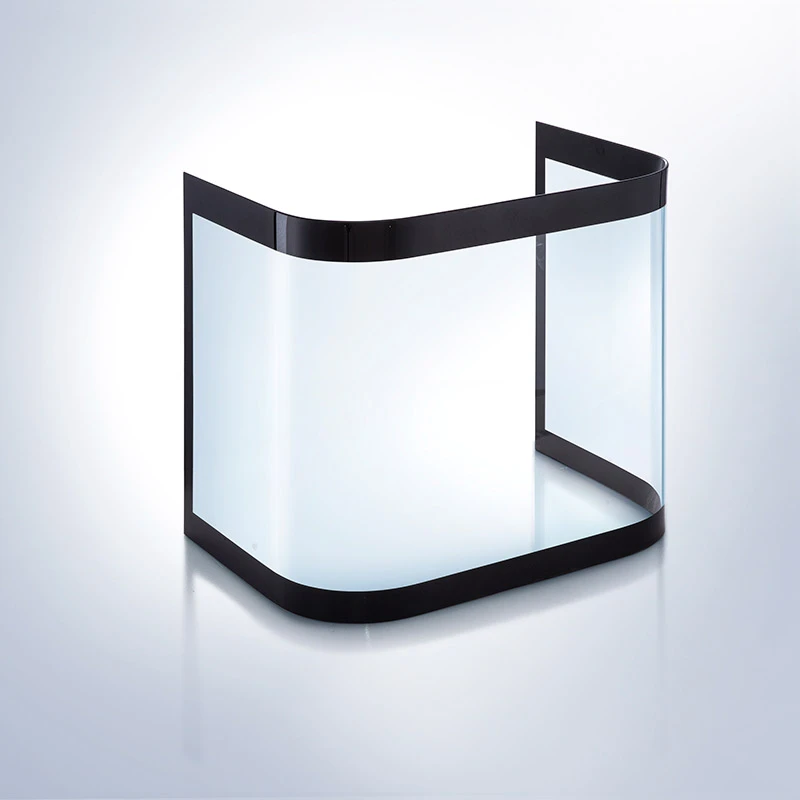
Knob holes, sensor slots and screw holes concentrate stress. The rule that holds in practice: distance from any hole edge to the panel edge at least twice the panel thickness, and hole interiors ground, not punched. Drawings that ignore this rule pass first articles and then break in transit or assembly. Supply your hole pattern with the RFQ and ask for a manufacturability (DFM) reply rather than a bare quote — a supplier who replies with revised hole placements is one who actually runs the cutting line.
The printed interface zone on an induction cooker glass panel survives wiping, heat and cleaning fluids only when the ink is fired into the glass. Organic and UV-cured printing look identical on day one and fail within months. Specify sintered ink, request a cross-hatch adhesion result, and align symbol registration against your artwork. The same process discipline covers wall-hung boiler panels and other appliance fronts where print sits over a heat source.

For China-market appliances, CCC applies through the finished appliance; the panel supplier should still hold ISO 9001:2015 and provide material and test traceability per lot. For export programmes, align the panel's glass safety documentation with the destination standard before tooling release.
Batch consistency is the check most buyers skip and most disputes come back to. Three lot-level records settle it: thickness and warp measurements per batch, colour difference against the approved reference panel, and temper records by batch number. Write all three into the contract; they cost the supplier nothing extra to produce and cost you weeks in a claim.
Thicker is safer. Beyond the product class, extra thickness raises the coil gap and reduces delivered power; survival comes from temper quality and edge work, not thickness alone.
First article equals batch quality. A hand-finished sample proves capability; only lot-level records prove production consistency.
Any printer can do the interface. Fired-in sintered printing requires a screen line and a furnace; ask which process, not which price.
Q: Can panel dimensions and hole patterns be fully custom?
A: Yes. Panels are produced to drawing with CNC cutting and waterjet hole work; send the drawing with tolerance callouts and the factory returns a DFM assessment with sample lead time.
Q: What is a realistic sampling timeline?
A: For a straightforward panel with fired printing, sample runs typically land within one to two weeks including printing and tempering, depending on tooling state.
Huayin Glass Solutions has processed tempered and curved glass for appliance programmes since 2002 from a 6,000+ m² plant in Foshan, Guangdong, with CNC cutting lines, forced-convection tempering furnaces, double-edge grinding and a waterjet cutting centre under one roof, exporting to 50+ countries. Send your panel drawing to the engineering team for a DFM assessment and sample plan, or review our manufacturing capability and home appliance glass range first.
Further reading: Induction Cooker Glass Panel · Water Heater Glass Panel · Steamed Bun Machine Glass · Products
Add:No. 16 Xingye Road, Beijiao Town Industrial Park, Shunde District, Foshan City, Guangdong Province
PHONE: +86 13509957538
TEL: +86 0757-26131933
Email: huayin_glass@163.com

© 2026 Huayin Glass Solutions All Rights Reserved.


