


 Add:No. 16 Xingye Road, Beijiao Town Industrial Park, Shunde District, Foshan City, Guangdong Province
 PHONE: +86 13509957538
 TEL: +86 0757-26131933
 Email: huayin_glass@163.com

Chinese


Most anodized aluminium glass door complaints do not start on the visible face. They start at a cut edge that was never sealed, a hinge boss that pulled its threads after two thousand cycles, or a gasket groove that was 0.4 mm too wide and let the door breathe. The finish survives; the details around it do not. These are the seven questions buyers send us before they commit to a frame specification.
Anodizing is an electrochemical conversion of the aluminium surface into aluminium oxide. It is not a coating laid on top; it grows out of the metal, roughly half above the original surface and half below, which is why it does not chip or peel the way paint does. On its own it is hard, electrically insulating and reasonably corrosion resistant, but the oxide layer is porous and will stain in a humid, chlorinated or fatty environment.
E-coating closes that porosity. After anodizing, the profile is immersed in an electrophoretic acrylic or epoxy bath and the resin is driven into the pores by voltage, then cured. The result is a sealed oxide with a smoother, more uniform appearance and far better resistance to fingerprints, cleaning agents and salt.
For a commercial glass door the combination is worth the cost for two reasons. First, the frame is handled constantly and cleaned with alkaline agents; a bare anodized surface dulls within months. Second, an e-coated surface is far easier to bond to, which matters for the sealant at the glass bite and for the foam or gasket tape in the rebate.
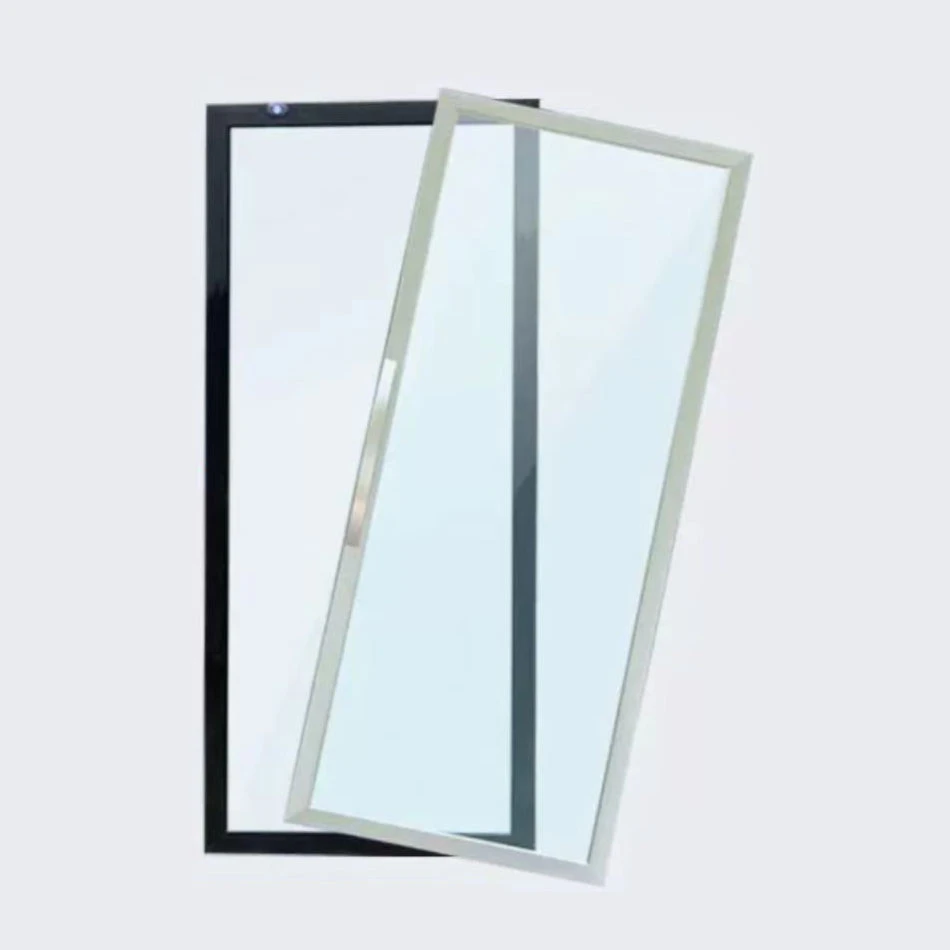
Write the numbers, not the words. "Anodized" on its own can mean 5 µm, which is decorative and fails in a coastal store within a year. The table below gives the values we see hold up in commercial refrigeration and food retail.
| Spec item | Value to write | Why it matters |
|---|---|---|
| Anodic layer | AA15 minimum, 15-20 µm | Below 10 µm the oxide is easily scratched through at corners |
| E-coat build | 15-25 µm, cured at 180 °C | Under-cured resin stays soft and picks up dirt in the rebate |
| Neutral salt spray | 500 h inland, 1,000 h coastal | ASTM B117 on a finished coupon, not on a bare extrusion |
| Colour tolerance | ΔE ≤ 1.5 against the approved sample | Keeps re-orders visually consistent on the same shop floor |
Two conditions make the difference between a coupon result and a real door. The coupon must be a finished part, including the cut ends and any drilled holes; spraying a polished test plaque proves nothing about a frame with forty machining operations. And the salt spray must follow a cross-hatch cut through the coating, because a scribed sample shows how the film behaves at damage, which is what actually happens on a shop floor.
Where the store sits within 5 km of the sea, or the door is cleaned daily with chlorinated sanitiser, go to the top of each range and add a wax or dry-film lubricant on the gasket line. It costs very little and roughly doubles the interval before white corrosion appears at the sill.
The glass bite is where water gets in. A commercial door normally carries 12-15 mm of glass edge inside the profile, set on two spacer blocks at the quarter points and bedded in a two-part polysulfide or neutral silicone. Three details decide whether that joint survives.
First, the rebate must be primed. Sealant does not bond reliably to a cured e-coat without the correct primer; the joint looks fine at assembly and peels cleanly six months later. Second, the seal must be continuous around the full perimeter with no thin spots at the corners, which is where the applicator gun changes direction. Third, drainage must never be blocked. Most aluminium door profiles have small weep slots at the bottom; sealing them to make the door "more waterproof" traps water against the glass edge and accelerates the corrosion it was meant to prevent.
On the glass side, the edge should be polished or at least fine-ground before tempering, and any drilled hole within 25 mm of the edge treated as a leak path and potted. A raw, chipped edge sitting in a wet rebate is the single most common cause of the milky white corrosion line that appears along the bottom of doors in humid markets.
Aluminium is soft, and a hinge screw is a point load repeated tens of thousands of times. Every hinge position needs either a wall thickness of 2.5 mm or more, or a steel backing plate inside the profile, or a rivet nut. Self-tapping screws straight into a 1.5 mm extrusion wall will hold at installation and strip within a year of daily use.
The load calculation is simple and should be shown by the supplier: door mass, hinge count, and a safety factor of at least 1.5 on static load, 2.0 where the door is used as a leaning point. A 1.8 m door with a laminated screen unit can pass 55 kg, so two hinges carry roughly 40 kg each after the factor. A hinge boss designed for a 25 kg display door will sag visibly under that.
Reinforcement also has to be sealed. Every steel insert is a dissimilar-metal contact, and in a wet environment that is a galvanic cell. Specify zinc-plated or stainless inserts, isolate them from the aluminium with a coating or a nylon sleeve, and make sure the fixing does not open a path from the rebate to the outside face.
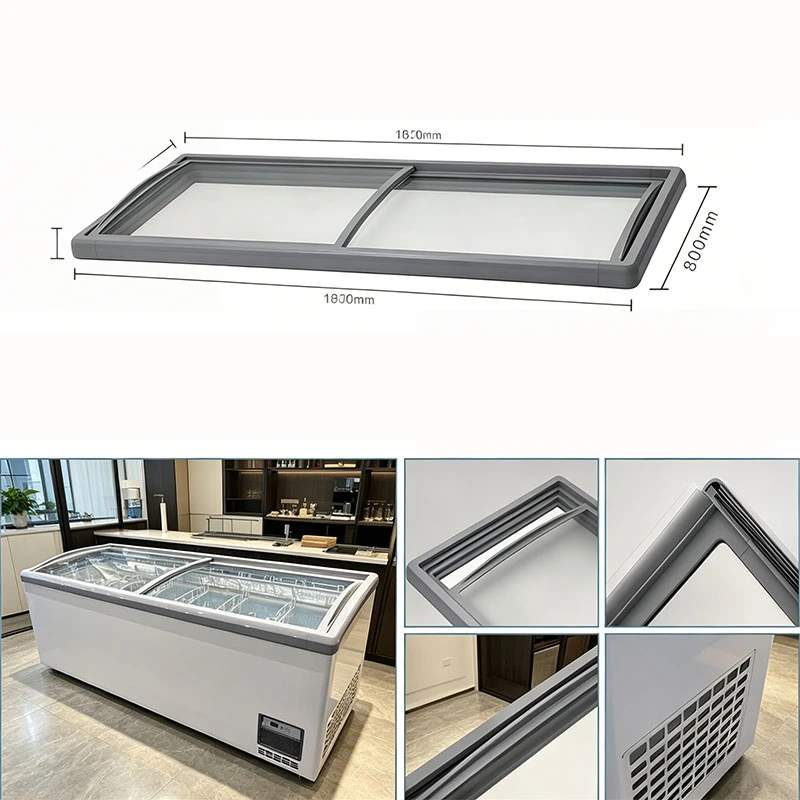
The magnetic gasket is only as good as the groove that holds it. Three tolerances do most of the work: groove width, groove depth and frame straightness. A groove that is 0.3 mm wide lets the gasket sit loose, so it lifts at the corners on every open cycle and never reseats. A groove too narrow compresses the bulb permanently and the gasket takes a set within weeks.
Practical figures for a commercial door: groove width ±0.2 mm on the nominal, depth ±0.3 mm, frame straightness within 1.5 mm per metre, and corner joints within 0.5 mm of flush on both faces. Diagonals should match within 2 mm on a door over 1.5 m, otherwise the gasket compresses unevenly and one corner always shows a light gap.
Ask for a section drawing with the gasket in place rather than a profile drawing alone. The two are rarely the same, and most sealing complaints trace back to a groove dimension copied from a different gasket series. If the door is retrofitted with a new gasket, match the bulb diameter to the groove depth before changing anything else; a larger magnet does not fix a groove that is the wrong size.
Anodizing colour comes from the oxide thickness plus a dye or a metal salt in the pore, and every bath drifts with age, temperature and load. Two runs of the same nominal colour can differ by two or three ΔE, which is invisible on a sample card and obvious when two doors stand side by side under shop lighting.
The controls are straightforward but rarely applied. Keep one approved physical sample per colour, signed and dated, and measure each lot against it. Record the anodizing bath, the dye lot and the e-coat batch on the frame label. Where a project has a long delivery schedule, produce the whole order in as few anodizing batches as possible and hold spare frames from the same batch — the spares are what save a store refit two years later.
For very light colours and for black, anodizing is the hardest finish to keep consistent. On those colours many suppliers move to a painted or powder-coated frame; that is a legitimate choice, but it is a different specification, with different scratch and chemical behaviour, and should not be approved as an equal substitute mid-project.
A factory acceptance test on this product is quick, and almost entirely dimensional and chemical. Six checks cover it: coating thickness on three points per frame with an eddy-current gauge; salt-spray coupon with a scribe, from the same bath as the production lot; sealant adhesion by peeling a 100 mm section at a corner and confirming cohesive failure; gasket compression measured with a feeler gauge at four points; door geometry, including diagonal difference and sag after fifty open-close cycles; and a water spray test on the closed door for two minutes with no ingress past the seal line.
At goods-in, repeat the geometry and gasket checks on 10% of the shipment and look specifically at the cut ends, the weep slots and the hinge bosses. Those three places carry nearly all of the field risk, and all three can be inspected in under a minute per door.
Huayin Glass Solutions machines, anodizes and assembles anodized e-coated aluminium glass doors alongside the glass itself, so the rebate tolerance and the glass edge are matched before either reaches the assembly bench. Frames are built to the refrigerator glass door platform or as a standalone door, and paired with magnetic door gaskets and self-closing hinges from the same programme. Send a section drawing, door mass and the store environment to our engineering team for a frame specification; manufacturing capabilities and freezer glass options are quoted as one package.
Further reading: refrigerator glass door · magnetic door gasket · manufacturing capabilities · ITO versus anti-fog coating
Add:No. 16 Xingye Road, Beijiao Town Industrial Park, Shunde District, Foshan City, Guangdong Province
PHONE: +86 13509957538
TEL: +86 0757-26131933
Email: huayin_glass@163.com

© 2026 Huayin Glass Solutions All Rights Reserved.


