


 Add:No. 16 Xingye Road, Beijiao Town Industrial Park, Shunde District, Foshan City, Guangdong Province
 PHONE: +86 13509957538
 TEL: +86 0757-26131933
 Email: huayin_glass@163.com

Chinese


A dual-zone wine cabinet puts two different climates behind one piece of glass. The upper compartment holds reds at 16°C, the lower holds whites at 6°C, and a horizontal mullion divides them. From the outside it looks like a single clean door. From the glass side it is two thermal environments meeting at a 10K step, with a metal divider, a light strip and a touch overlay all competing for the same 20 mm of edge.
This programme started with a brand that had already launched a single-zone model and wanted a two-zone flagship without changing the cabinet tooling. The door had to fit the existing opening, carry a printed logo, respond to touch through the glass, and stay clear in a 30°C, 75%RH showroom. The first prototype failed on exactly one point: a fog band that followed the mullion from the hinge side to the handle side. Getting rid of it took three iterations and reshaped the whole build-up.
The cabinet was already in production. Its opening was 598 mm wide and 1,180 mm high, with a hinge pattern that had been designed for a 6 mm single pane and a 24 mm frame. Moving to an insulated unit meant adding roughly 5 kg to the door and moving the centre of gravity outward, which the existing hinge could not take.
Three constraints framed the job. The door had to keep the same outer dimensions, so all the added thickness had to live inside the frame. The touch panel had to work through the glass without a cut-out, because the brand wanted a flush front. And the perimeter LED had to run continuously around the door without a visible seam at the corners, which is where most lit doors show a dark segment.
The commercial side was equally tight: the brand planned a spring launch in two markets and needed first articles within ten weeks, with volume ramping to 4,200 doors over 14 months across nine widths and heights.
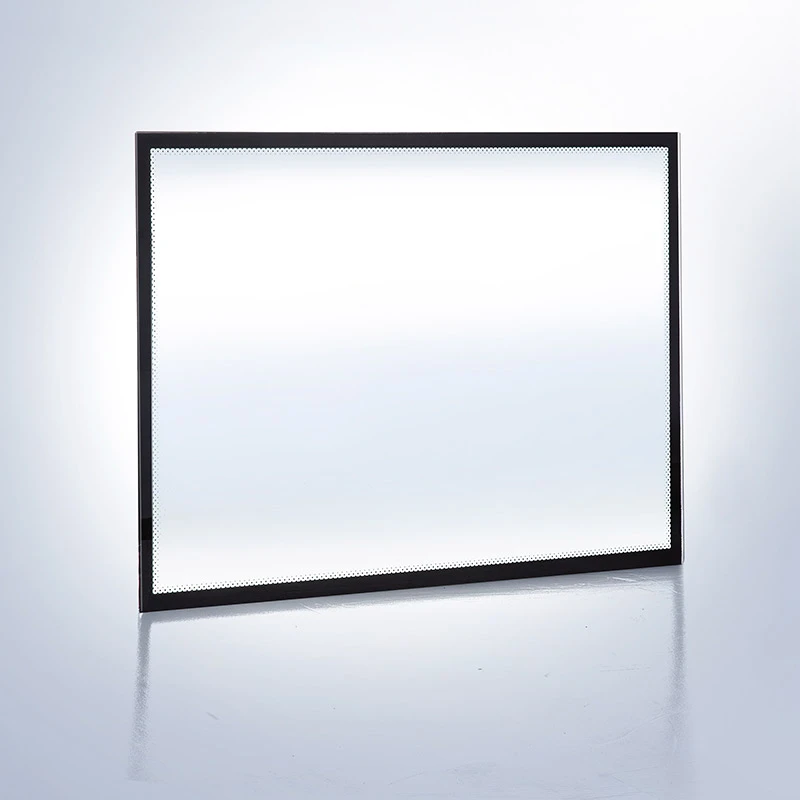
Splitting the specification into fixed and open items early saved two rounds of sampling. The brand fixed the appearance, the opening size and the touch behaviour; the glass build-up, the mullion treatment and the LED integration were left to us.
| Requirement | Target | How it was verified |
|---|---|---|
| Clarity in showroom conditions | No fog on the outer face at 30°C / 75%RH | Climate chamber, surface thermocouples at nine points |
| Thermal performance | U ≤ 1.6 W/m²K centre of glass | Build-up calculation plus guarded hot plate on coupons |
| Touch response | Reliable through 5 mm glass, no ghost triggers | 1,000-cycle actuation at 6°C and 16°C zone temperatures |
| Lighting | 3,000 K, CRI > 90, no visible dark segment | Corner luminance measurement, 100% visual inspection |
| Logo | ΔE ≤ 1.5 against brand standard, no edge bleed | Spectrophotometer at D65, 5 points per door |
| Durability | No seal breach after 3 thermal cycles, -10°C to +40°C | Dew point check after cycling, visual at raking light |
Two items were deliberately left loose. The first was glass thickness, as long as the U-value and weight budget held. The second was where the touch tail exited, which we moved from the bottom edge to the hinge side after the first prototype, because the bottom edge is the coldest part of the door and the tail was acting as a wick.
Prototype one used a straightforward 5+12A+5 unit with Low-E on face 3 and a passive aluminium mullion. In the chamber it fogged in a horizontal band about 40 mm tall, centred on the divider, within eleven minutes. The cause was not the glass: the aluminium mullion conducted the 6°C zone temperature up into the outer pane, dropping the surface below the room dew point in a narrow strip.
Prototype two added a thermal break in the mullion and a 25 W trace on the divider. The band shrank but did not disappear, and a new symptom appeared at the hinge side: a crescent of condensation that followed the frame, traced to the LED channel sitting directly against the outer pane and acting as a cold bridge of its own.
Prototype three solved both with geometry rather than more power. The mullion was moved 6 mm inboard so the divider no longer touched the outer pane, the LED channel was isolated with a 2 mm thermal gasket, and the trace was reduced to 18 W because the heat now had somewhere to go instead of leaking into the frame. The band disappeared at 30°C / 75%RH and did not return at 32°C / 80%RH, which was the worst case the brand could test.
The lesson is worth restating for any dual-zone door: a powered fix on a conductive path treats the symptom. Break the path first, then size the heat.
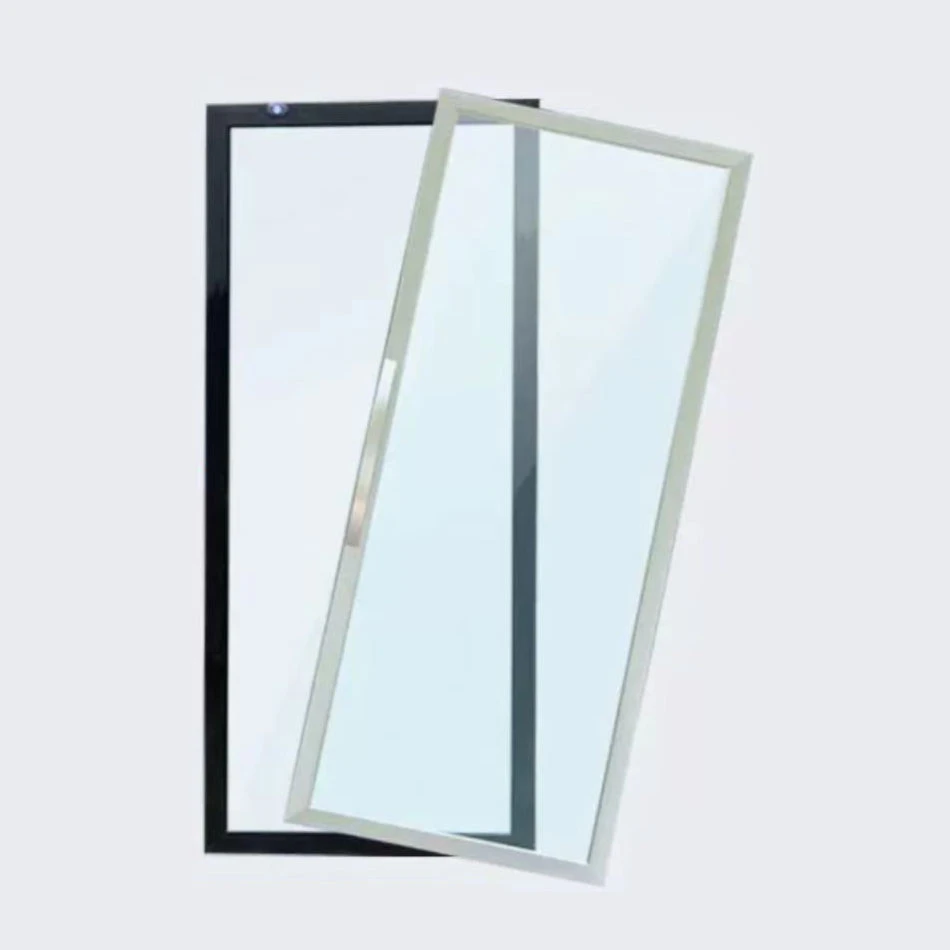
The final door is a single insulated unit spanning both zones. Low-E sits on face 3 so the coating faces the cavity, argon fill is held above 90%, and the spacer is warm-edge with a dual seal. The outer pane carries the printed logo and a hard anti-fog coating is deliberately omitted, because the brand wanted the coating-free surface for cleaning with standard glass products.
The electrical layer has three separate circuits. The capacitive touch film is laminated to the inner face of the inner pane, with a flex tail exiting through the hinge side and potted at the frame. The perimeter LED sits in an isolated channel with its own 12 V feed. The mullion trace is on a 24 V circuit with a surface sensor, not on a timer, so it only draws power when the divider temperature approaches the dew point.
Weight came out at 27.5 kg for the 598 × 1,180 mm door, against 21 kg for the original single-pane version. The hinge was re-specified to a three-point pattern with 1.4 times the calculated load, and the frame was given slotted fixings so the aluminium could move without cracking the corner joints.
Sixty pilot doors were built across the three most common sizes and run for eight weeks in a chamber cycling between 6°C and 16°C, with the room held at 30°C / 75%RH. Three issues surfaced that no drawing review would have found.
The first was touch ghosting at low temperature. At 6°C the capacitive film's baseline drifted, and the controller registered phantom touches near the divider. The fix was a firmware baseline recalibration on power-up, plus a 1 mm reduction in the film's active area away from the mullion. The second was a faint bright spot in the LED at the top corners, where the light guide bent; changing the bend radius from 8 mm to 14 mm removed it. The third was a slow dew point rise on four doors after the second thermal cycle, traced to a secondary seal that had been applied too thin on one shift.
| Pilot finding | Root cause | Corrective action |
|---|---|---|
| Fog band at mullion | Conductive divider touching the outer pane | Mullion moved inboard 6 mm, 18 W trace added |
| Ghost touch at 6°C | Capacitive baseline drift | Recalibration on power-up, active area trimmed 1 mm |
| Bright spot at top corners | Light guide bend radius too tight | Bend radius 8 mm to 14 mm |
| Dew point rise on 4 doors | Secondary seal applied thin on one shift | Seal weight check added to shift start-up |
Volume started at 180 doors a month and reached 420 by month nine. Nine SKUs came from three widths and three heights, and the only parts that changed between them were the frame extrusion length, the LED guide and the touch film size. Keeping the glass build-up identical across all nine was a deliberate decision: it let us hold one coating batch, one spacer spec and one seal recipe, which is what made the ΔE and dew point numbers stay flat through the ramp.
Two production controls carried most of the quality. Every door got a 1,500 V hipot and an insulation resistance check before packing, and every batch got a dew point reading after 24 hours of settling. Doors were packed upright in slotted crates with the touch tail protected by a rigid channel, because a crushed tail is a dead door and cannot be repaired in the field.
Across 14 months and 4,200 doors, field returns for fogging came to 0.4%, all from a single batch traced to the seal issue found in the pilot. Touch returns were 0.2%, all connector-related and fixed by a longer tail. Logo colour held within ΔE 1.2 across the whole run.
| Metric | Target | Delivered |
|---|---|---|
| Fog returns | < 1.0% | 0.4% (single batch) |
| Touch or LED returns | < 0.5% | 0.2% |
| Logo colour deviation | ΔE ≤ 1.5 | ΔE 1.2 run average |
| Door weight | ≤ 28 kg | 27.5 kg |
| First article lead time | 10 weeks | 9 weeks |
Q: Would a heated outer pane have been simpler than the mullion trace?
A: It would have solved the fog band, at roughly 60 W/m² across the whole door and a permanently higher energy draw in a product sold on low consumption. The trace approach uses 18 W on a divider that is 4% of the door area, and only when the sensor calls for it. Heating is the right answer when the whole surface is at risk; when the problem is local, fix the local path.
Q: Can the same door be adapted to a 5°C to 20°C three-zone cabinet?
A: Yes, with one change: each additional divider needs its own isolated channel and trace, and the touch film has to be split into zones with separate baselines. Beyond three zones the wiring density in a 24 mm frame becomes the limiting factor, and a wider frame is usually the cheaper answer.
The programme is now in its second generation, with a rounded-corner variant and an ambient-light option. Both reuse the same build-up, which is the practical payoff of locking the glass early: new appearances ship without re-qualifying the thermal design. For a similar dual-zone or lit door programme, send the opening size, zone temperatures and target market to our engineering team; see wine cooler cabinet glass, touch control wine cooler doors and ambient lighting doors for the current range.
Further reading: wine cooler cabinet glass · manufacturing capabilities · featured projects · ITO versus anti-fog coating
Add:No. 16 Xingye Road, Beijiao Town Industrial Park, Shunde District, Foshan City, Guangdong Province
PHONE: +86 13509957538
TEL: +86 0757-26131933
Email: huayin_glass@163.com

© 2026 Huayin Glass Solutions All Rights Reserved.


