


 Add:No. 16 Xingye Road, Beijiao Town Industrial Park, Shunde District, Foshan City, Guangdong Province
 PHONE: +86 13509957538
 TEL: +86 0757-26131933
 Email: huayin_glass@163.com

Chinese


A blast freezer is not a cold room with a window. It pulls a load from +25°C to -40°C in under two hours, holds it, then defrosts and starts again. The door sees a 65K swing several times a day, and the glass is the part that has to survive it without fogging, cracking or shedding its seal. These are the seven questions procurement teams send us before specifying a blast freezer glass door.
Display freezers run at -18°C to -22°C and open dozens of times an hour. Blast freezers run at -35°C to -40°C and open a few times a shift, but each opening is a full air exchange with a warm, wet room.
The difference that matters is where the moisture lands. In a display freezer the problem is condensation on the outside face. In a blast freezer the inner pane sits far below the room dew point, so frost builds on the inside surface and on the frame, then melts during defrost and refreezes in the seal line.
That single shift changes the specification: the inner pane needs a surface that releases frost cleanly, the frame needs a thermal break that survives repeated freeze-thaw, and the seal needs a compound that stays elastic at -45°C rather than hardening into a gasket that no longer touches the glass.
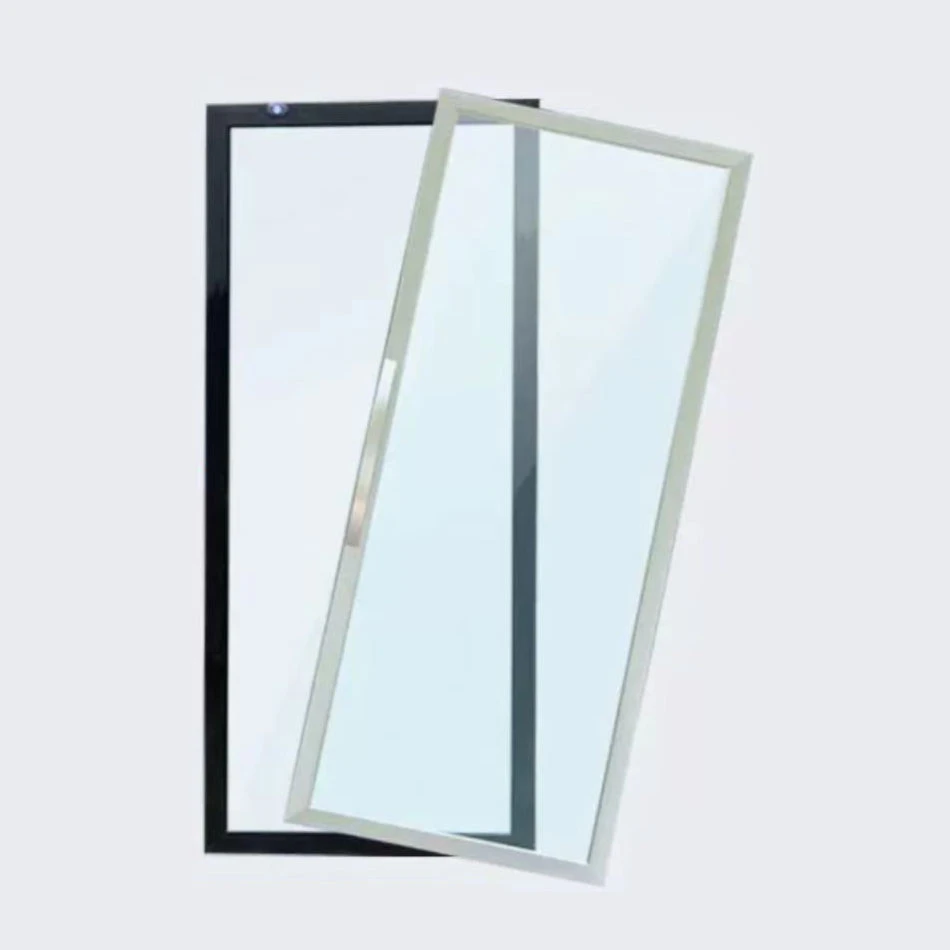
Centre-of-glass U-value is the wrong number to buy on here. What decides frost is the inner surface temperature, and that is driven by the build-up plus the frame, not by the pane count alone. The table below shows indicative values for a 1,200 × 700 mm door at -40°C inside and +25°C outside.
| Build-up | U-value | Verdict at -40°C |
|---|---|---|
| Single 6 mm tempered | 5.7 W/m²K | Inner face near -32°C, heavy frost, thermal shock risk on defrost |
| Double 5+12A+5, Low-E face 3 | 1.4-1.7 W/m²K | Workable to -25°C; at -40°C frost still forms on the inner face |
| Triple 4+12A+4+12A+4, two Low-E | 0.9-1.2 W/m²K | Inner face near -20°C, frost limited to seal line and frame |
| Heated double 5+12A+5 with ITO | 1.5 W/m²K plus heat | Surface held above dew point by control, not by insulation alone |
For continuous -40°C duty, triple glazing with two Low-E coatings is the baseline, and a heated outer pane is added where the room is humid or the door opens often. Weight is the hidden cost: a triple unit runs above 30 kg/m², so a 1.8 m door passes 100 kg before the frame is counted. Hinges and tracks must be sized from that figure, not from the glass thickness.
Power is set by the surface temperature you need to hold, not by the room temperature directly. The practical starting points below assume an insulated frame and a controlled supply, and they rise quickly if the door is single glazed or the frame is unbroken.
| Duty | Power density | Control logic |
|---|---|---|
| Display freezer, -18°C to -22°C | 150-200 W/m² | Dew point switching, 40-60% duty cycle |
| Blast freezer, -35°C to -40°C | 250-350 W/m² | Surface sensor plus dew point, continuous during freeze cycle |
| Door with triple glazing, low humidity room | 200-250 W/m² | Dew point switching, defrost interlock |
| High humidity room or frequent opening | 350-400 W/m² | Continuous with timer boost at door-open signal |
Two rules keep the number honest. Heat the outer pane, never the inner one: heating the cold-side pane pushes more energy into the chamber and creates a thermal gradient across the unit. And expect the insulated assembly to cut effective power by 30-40%, because the cavity and the second pane slow heat transfer to the room-facing surface. A 300 W/m² element behind an insulated unit behaves like roughly 180-210 W/m² at the surface.
Busbar layout decides whether the heat is even. On a flat panel, copper foil busbars at top and bottom give a uniform field. On a curved door, the busbar must follow the arc edge, with the terminals brought out at a corner so the cable does not cross the seal line.

Frost does not start in the middle of the glass. It starts at the coldest point of the assembly, which is almost always one of four places: the seal line where the gasket meets the pane, the bottom frame member, the edge of the inner pane above the spacer, and the terminal exit on a heated door.
Each has a different fix. At the seal line, the answer is a warm-edge spacer plus a gasket that stays compliant at low temperature; a hardened gasket leaves a capillary gap that pulls moist air in on every defrost. At the bottom frame, the answer is a thermal break and, where needed, a low-power frame trace. At the pane edge, the answer is edge heating or accepting a controlled frost band that clears in the defrost cycle. At the terminal, the answer is potting the exit and routing the cable away from the cold bridge.
The sequence matters during commissioning: measure surface temperature at those four points, not at the centre. A door that reads -18°C in the middle and -38°C at the bottom seal will frost at the seal and pass a centre-point check.
Materials change behaviour well before they fail visibly. Standard PVC gaskets stiffen sharply below -25°C, so compression set climbs and the magnetic pull is no longer enough to seat the profile. A low-temperature compound, usually silicone or a modified EPDM, keeps elasticity to -50°C or lower. The magnet grade may also need to rise one step, since cold reduces holding force and the gasket is less able to conform to the frame.
Aluminium contracts about 2.3 mm per metre over a 65K drop. On a 1.5 m door that is roughly 3.5 mm of movement, enough to open a corner joint if the frame is rigidly fixed at both ends. Frames need slotted fixings or a compliant gasket line to absorb it. Hinge grease thickens, so door torque rises; specify low-temperature grease and a hinge with 1.3-1.5 times the calculated load, and expect opening force to climb 20-40% at -40°C compared with ambient.
Stainless hardware avoids the rust stain that appears on zinc-plated parts after a few defrost cycles. Any screw that passes through the spacer or lands within 25 mm of the glass edge should be treated as a leak path and sealed, not just tightened.
A blast freezer door is specified by numbers that can be tested, not by adjectives. Six items cover most of the risk.
Dew point: -60°C or lower on the insulated unit, tested per batch, with the record shipped alongside. Heating circuit: resistance within ±5% of nominal, insulation above 100 MΩ, and a 1,500 V hipot for one minute. Thermal cycling: three cycles from +25°C to -40°C and back, with no delamination, no seal breach and no change in dew point. Defrost behaviour: frost clears from the viewing area within the stated time without water tracking into the frame. Door geometry: sag no more than 1.5 mm after the cycle test, diagonal difference within 2 mm. Documentation: furnace batch, coating batch, gasket lot and a photo record of the seal line at each corner.
Ask for the test report format before the order, not after. A supplier who cannot show a dew point log per batch is unlikely to produce one when a claim arrives.
Start with four numbers: chamber temperature, room temperature and humidity, door size, and openings per shift. Those four decide the build-up, the power density and the frame detail, and they cost nothing to collect.
From there, the sequence is drawing review, a small pilot batch, then a factory test on the actual assembly rather than on a sample pane. Projects that fail usually skip the pilot and discover the seal problem in the first defrost cycle on site.
Huayin Glass Solutions processes heated insulated glass, coated curved tempered heating units and curved defogging panels in one facility, so the coating, bend, busbar and lamination steps stay under one quality record. Send the four numbers and a drawing to our engineering team for a build-up recommendation; freezer glass and magnetic door gaskets can be quoted as a matched set.
Further reading: freezer glass · manufacturing capabilities · client projects · ITO versus anti-fog coating
Add:No. 16 Xingye Road, Beijiao Town Industrial Park, Shunde District, Foshan City, Guangdong Province
PHONE: +86 13509957538
TEL: +86 0757-26131933
Email: huayin_glass@163.com

© 2026 Huayin Glass Solutions All Rights Reserved.


