


 Add:No. 16 Xingye Road, Beijiao Town Industrial Park, Shunde District, Foshan City, Guangdong Province
 PHONE: +86 13509957538
 TEL: +86 0757-26131933
 Email: huayin_glass@163.com

Chinese


Buyers usually arrive at defog glass through a complaint, not through a specification: doors fogging in a humid season, staff wiping glass between customers, a competitor's cabinet staying clear. The first quote request then names a technology — ITO, wire, fan — before anyone has established why the glass fogs at all. This checklist works the other way round, from dew point outward, so the technology choice falls out of the operating conditions rather than the supplier's catalogue.
Key takeaways
Condensation forms when a surface drops below the dew point of the air touching it. In a store at 28°C and 80% relative humidity, dew point sits near 24°C; a single-pane freezer glass door over a 3°C cabinet runs far below that, so fog is inevitable regardless of coatings. Two readings taken over 48 hours — door surface temperature and door-zone humidity — tell you how many degrees of lift the glass needs.
That number, not the supplier's recommended wattage, is the design input. A door needing 3°C of lift and a door needing 8°C of lift are different products, and quoting them at the same power density is how projects end up with half the cabinets clear and half still fogging.
ITO coating and resistance wire both convert electricity to heat at the glass surface; forced air changes the air rather than the glass. The practical differences are where the heat lands, what the customer sees, and how the unit fails.
| Criterion | ITO coated glass | Wire-heated / forced air |
|---|---|---|
| Heat distribution | Full-surface film, uniform when busbars are placed well | Wire: banding between elements. Air: uneven near door edges |
| Visibility | No visible element in the viewing area | Wire pattern visible under direct light; air needs duct space |
| Typical power | 120-250W/㎡ depending on cabinet temperature | Wire similar; air adds fan load continuously |
| Dominant failure | Terminal corrosion or busbar damage | Wire break, or fan failure unnoticed until fog returns |
| Best fit | Display doors where appearance sells the product | Back-room or service doors where appearance matters less |
For a retail display door, the decision is usually ITO by default: no visible element, even heat, and a failure mode that can be designed around with terminal encapsulation. Wire remains sensible on utility doors and on retrofits where the existing door cannot be re-glazed.
Heating a single pane means fighting the whole heat loss of the door. Put the heated pane on the outside of an insulated unit and the gas cavity carries part of the load, cutting the required density by 30-40%. On a −18°C cabinet this is the difference between 220W/㎡ and something closer to 150W/㎡, and it compounds over years of electricity bills.
The cavity itself must be right: 12-16mm wide, argon filled to at least 85%, Low-E coating on the third surface, warm-edge spacer and dual seal. Below 9mm the gas conducts instead of insulating; above 18mm convection inside the cavity erodes the benefit. If the unit is not built this way, adding power is the expensive substitute for fixing the heated insulated glass specification.
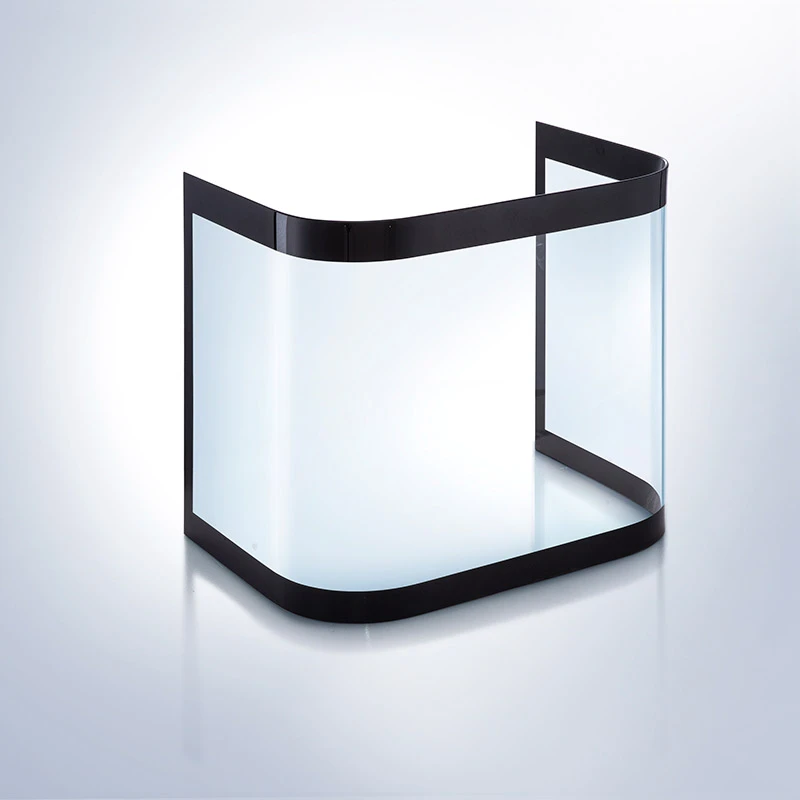
On a curved defogging panel, current has to travel along the arc, so busbars are placed along the curved edges and the terminals exit at a corner rather than on a straight edge. Skipping that leaves a band of fog that no increase in wattage clears, because the current path is longer than the coating was designed for. Curved panels also require coating before bending, so the film forms with the glass; coating an already-bent pane produces visible waviness under display lighting. See coated curved tempered anti-fog glass for the process sequence.
Field data from service returns concentrates on the same four locations. Terminals: moisture ingress causes electrochemical corrosion, and the symptom is a door that heats unevenly after two or three months. Busbar edges: handling damage before tempering shows up as a cold strip along one side. Gaskets: compression outside 30-50% opens a path for warm air, so the door fogs at the edge even with heating on. Sensors: mounted where cold air passes, they read low and hold the heater at full power, doubling consumption without improving clarity.
All four are specified, not discovered. Terminal encapsulation, busbar protection in handling, a stated gasket compression range and a sensor location drawing belong in the purchase order.
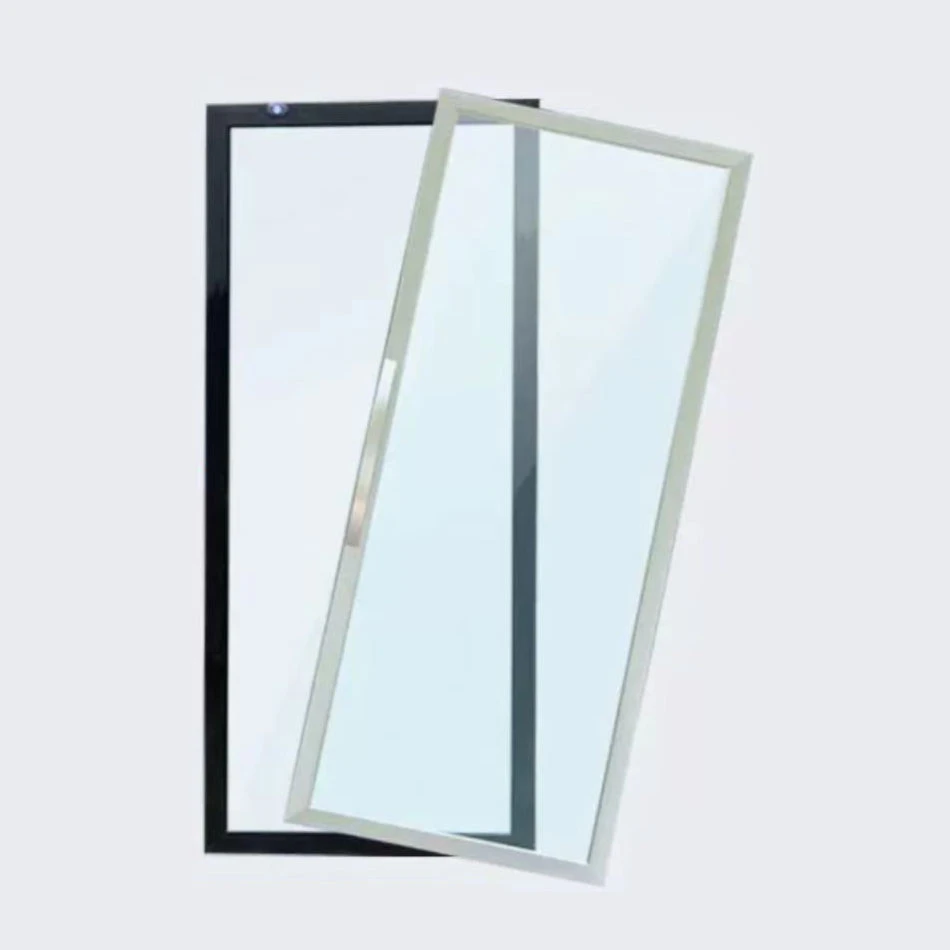
If the fog is at the edge, more power only moves the boundary. Fix the magnetic door gasket and the frame first.
Hydrophilic coatings spread droplets into a film and help in moderate humidity; they do not raise surface temperature, and they wear with cleaning. In a high-humidity store they postpone fog by minutes, not hours.
Coating after tempering risks local annealing and lowers adhesion. Uniformity on a curved surface depends on the fixture, so samples must be checked by thermal camera before volume release.
Need a power density recommendation for a specific cabinet? Send door dimensions, cabinet temperature, humidity data and whether the panel is curved to our engineers through the contact page. Coating, bending, tempering and insulated assembly run under one roof at our manufacturing facility in Foshan, which keeps the defog glass, frame and gasket tolerances in a single supply chain.
Further reading: Curved tempered coated heated IG glass · Commercial supermarket freezer glass · ITO heating vs defogging coating
Add:No. 16 Xingye Road, Beijiao Town Industrial Park, Shunde District, Foshan City, Guangdong Province
PHONE: +86 13509957538
TEL: +86 0757-26131933
Email: huayin_glass@163.com

© 2026 Huayin Glass Solutions All Rights Reserved.


