


 Add:No. 16 Xingye Road, Beijiao Town Industrial Park, Shunde District, Foshan City, Guangdong Province
 PHONE: +86 13509957538
 TEL: +86 0757-26131933
 Email: huayin_glass@163.com

Chinese


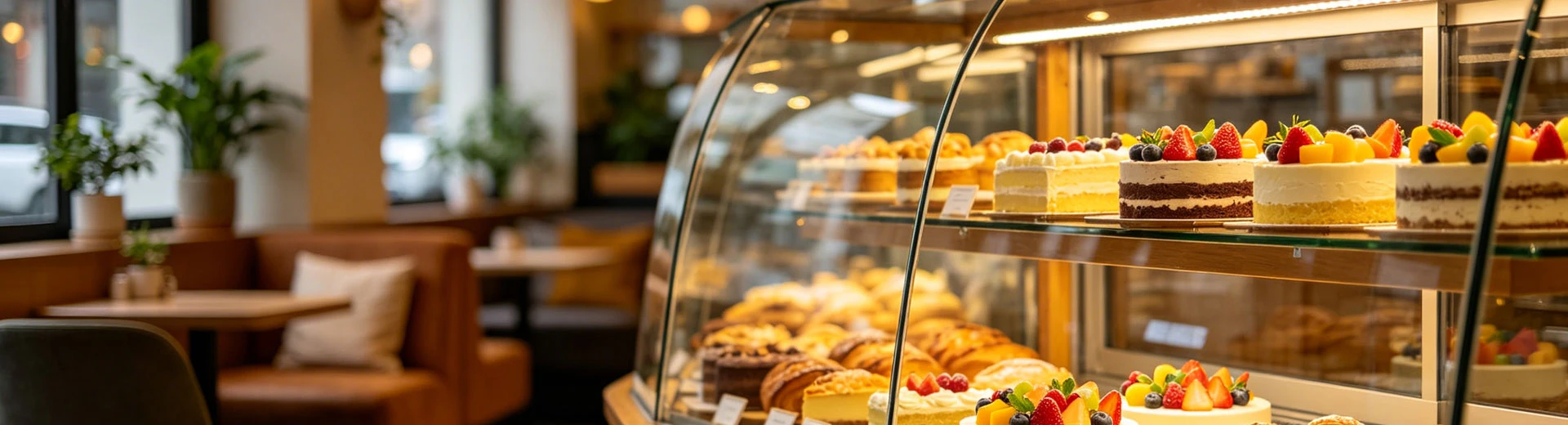
A curved front turns a pastry cabinet into a lightbox: the glass pulls the display forward, LED strips run deeper along the arc, and cakes read from three metres away instead of one. The merchandising case is easy. The sourcing case is harder, because curved pastry display cabinet glass fails in ways flat doors never do — wavy reflections under dense lighting, fog that retreats in stripes, stepped edges that seat unevenly in the frame. Every one of those failures traces back to a decision made before the first quote, so the six specs below are ordered by the sequence in which you should lock them.
Curved fronts earn their premium on three cabinet types: island cake displays with a single sweeping arc, upright pastry cases with a bowed front door, and combination units that mix a flat service side with a curved customer side. In each, the glass is a merchandising component, not just a cover — which is why the radius, the light transmission and the edge detail all deserve specification rather than "make it look like the sample".
The cost side is just as specific. Curvature adds mold tooling, tightens the tolerance chain, and — if the cabinet runs chilled in a humid store — pushes you toward heated or insulated options that a flat door would not need. Knowing which of those costs apply to your cabinet is what the next five sections are for.
The first fork in the road is the forming process, because it determines strength, safety classification and how coatings interact with the curve. Hot bent glass is formed by heating the sheet until it slumps over or into a mold; curved tempered glass is bent and quenched in a single pass through a bending tempering furnace, picking up the same stress profile as flat tempered glass.
| Item | Hot bending | Curved tempering |
|---|---|---|
| Strength & thermal shock | Annealed-level; weak against impact and gradients | 4–5× stronger; tolerates freezer gradients |
| Break pattern | Large sharp shards | Small granules (EN 12150 / ANSI Z97.1) |
| Radius freedom | Very high — S-curves, compound shapes | Single-radius arcs, R300–R2000 typical |
| Coated or heated options | Limited; coating after bending is unreliable | Full range — coat before bending and temper |
| Best for | Decorative panels, non-safety curves, lamination blanks | Doors and front panels on chilled pastry cabinets |
For any chilled or self-service cabinet, curved tempered is the default: food-safety codes and retailer risk policies expect safety glass on customer-facing panels, and hot bent annealed glass only qualifies after lamination — one more cost layer most pastry projects do not need. Reserve hot bending for S-shaped decorative elements or as the forming blank for hot bent laminated glass.
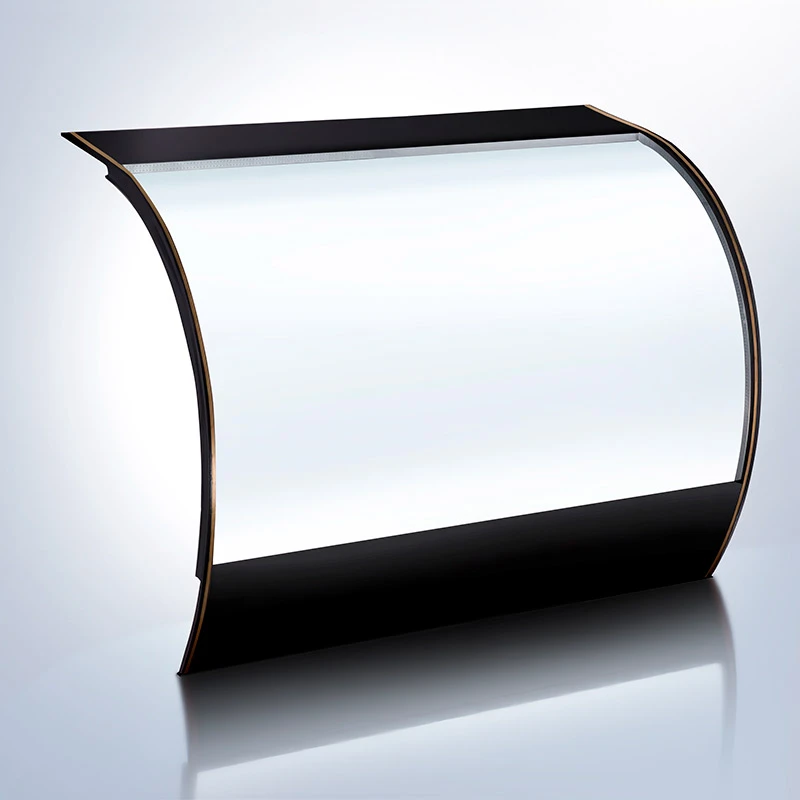
Most quoting delays on curved pastry display cabinet glass come from incomplete geometry. A supplier can quote in hours from three numbers: chord length (the straight distance between the arc's ends), rise (the height of the arc above the chord), and the radius they imply. Any two of the three define the arc; sending all three lets the supplier flag contradictions before they become scrap.
Add the edge details while you are at it. If the glass seats into a frame groove, send the stepped-edge width and height, not a photo of the extrusion. If hinges or handles mount on the glass, send hole positions with edge distances — holes in a bending zone or closer than 2× glass thickness to the edge are the two geometries a tempering line will reject. Acceptable submissions, in order of reliability: a CAD curve, a dimensioned sketch with chord and rise, or a physical paper template from the actual frame.
The build-up decision follows the cabinet temperature and the store climate, not the catalogue. Three configurations cover nearly every pastry project.
| Build-up | Best for | Watch point |
|---|---|---|
| Single curved tempered 4–5 mm | Ambient dessert cases, dry air-conditioned stores | No thermal buffer — condensation risk rises with humidity |
| Curved IGU 4+12A+4, argon, low-E | Chilled display 0–10 °C, standard humidity | Spacer and seal quality decide the edge temperature |
| Heated curved IGU with conductive coating | High-humidity stores, doors opened frequently, cold cases | Busbar routing and power density need project-specific design |
An insulated glass unit earns its cost on chilled cases by lifting the inner surface temperature above the dew point, which is what actually stops edge condensation. The heated option adds a transparent conductive film and busbars — worth it when misting complaints, not energy bills, are the problem. Both curved insulated options are covered in the thermally bent glass range, and the heating variants are detailed on the hot bent insulated heating glass page.
If your build-up includes low-E or a heating film, the coating order is the single most important process fact to confirm: coatings go on while the glass is still flat, and the sheet is then bent and tempered in one pass. Coating after bending produces the two defects buyers see in the field — thickness variation across the arc, and visible interference bands under store lighting.
On a curved IGU, the low-E coating sits on surface 3 (counting from the outside), where it reflects interior heat back into the cavity without sitting in the visible reflection path. This is the same convention used on flat freezer doors, and it is verifiable with a transmission meter on arrival.
For heated curved panels, expect a power density between roughly 150 and 350 W/m² depending on case temperature and humidity, with the busbars running along the arc edge — not the straight edges as on flat doors — so the current path matches the arc. Terminals should exit from a corner, outside the viewing area. A supplier who quotes a single catalogue wattage for every radius is quoting from a flat-glass datasheet.
Both approaches are specialized forms of curved defogging panels; the dedicated build is described on the coated curved tempered anti-fog glass page, and the insulated heated version on the curved tempered coated heated IG glass page.
Curved geometry has one extra tolerance that flat doors do not: the arc itself. Three numbers decide whether a curved pane drops into the frame without forcing it.
For insulated and heated build-ups, add two functional checks. Ask for the dew point of the IG batch — −40 °C per EN 1279 is the working standard — and run an infrared camera check on heated samples: surface spread should be even within about 5 °C and mist should clear within 90 seconds at rated power. Batches without these two records are the most common source of "foggy door" claims six months later, a failure mode covered in more depth in our freezer glass guides and the ITO vs anti-fog coating comparison on the blog.
Curved projects front-load their schedule in tooling. If a mold for your radius already exists, samples of four to ten pieces take about 7 to 10 working days; if a new mold is required, add mold making time before the first sample, and expect the mold cost to be quoted separately or amortized against volume. After sample approval, production runs of a few hundred pieces typically ship in 20 to 30 days, with insulated and heated build-ups at the longer end because of the assembly and testing steps.
Two commercial notes worth writing into the PO. First, treat the approved sample as the quality reference for chord height, edge finish and optical clarity — later batches are judged against it, not against a catalogue. Second, confirm export packaging: curved panes travel best in vertical crates with matched contours, and loading photos from a previous curved order are a fair thing to ask for.
Q: Can any curve be tempered?
A: No. Bending tempering lines handle single-radius arcs within a defined range — roughly R300 to R2000 for display-cabinet sizes — and reject glass with holes or cutouts inside the bending zone. S-curves and compound shapes need hot bending, usually followed by lamination to meet safety requirements.
Q: Do I need heated glass on a pastry cabinet?
A: Only if condensation is a documented problem in your target stores. A dry, air-conditioned bakery rarely needs it; a high-humidity store with frequent door openings usually does. The cheap test is a wet-bulb reading at the worst store — above roughly 75% relative humidity, plan for a heated or insulated build-up.
Q: Single pane or insulated glass unit?
A: For ambient cases, single tempered panes keep cost and weight down. From 0 °C downward, an IGU pays for itself in condensation control and compressor cycling, and the heavier build-up also stiffens the curved front against door-slam loads.
Curved pastry cabinet glass rewards buyers who lock the route, the geometry and the build-up before asking for prices — because those three decisions are what every quote is actually pricing. Send chord, rise and radius with your cabinet drawings, and the rest of the specification becomes a conversation about verification rather than guesswork.
Planning a curved pastry or cake display project? Send your arc dimensions, cabinet temperature range and target store climate to our engineering team for a DFM review and sample quotation, and we will confirm the process route, build-up and tolerance plan for your drawing. The full range is available on the products page.
Further reading: Manufacturing capability · Client cases · Featured projects
Add:No. 16 Xingye Road, Beijiao Town Industrial Park, Shunde District, Foshan City, Guangdong Province
PHONE: +86 13509957538
TEL: +86 0757-26131933
Email: huayin_glass@163.com

© 2026 Huayin Glass Solutions All Rights Reserved.


