


 Add:No. 16 Xingye Road, Beijiao Town Industrial Park, Shunde District, Foshan City, Guangdong Province
 PHONE: +86 13509957538
 TEL: +86 0757-26131933
 Email: huayin_glass@163.com

Chinese


Argon fill is the parameter most often written into insulated glass unit quotations and least often verified at delivery. In a freezer door, the gas inside the cavity does a measurable share of the thermal work: dry argon conducts roughly one third less heat than air, so the difference between a 95 percent fill and a 70 percent fill shows up directly in compressor run time and in the surface temperature of the outer pane. This brief defines the four parameters that govern IGU performance — fill concentration, cavity width, retention, and verification — and how each should appear in a purchase order.
Heat crosses an insulated glass cavity by three mechanisms: conduction through the gas, convection within the cavity, and radiation between the panes. Argon addresses the first. Its thermal conductivity is about two thirds that of air, and its higher density suppresses convection currents at the cavity widths used in door glass. Radiation is left to the Low-E coating, which reflects the infrared component.
The practical consequence for buyers: argon and Low-E are not alternatives, they are complements. A Low-E coated cavity filled with air gives up a large share of the coating's benefit, because conduction through the air gap becomes the dominant remaining path.
Fill concentration decays from the moment of filling; what matters is the value achieved at the filler and the value retained at delivery. Industry practice specifies a minimum of 85 percent at shipment, with well-controlled automatic lines reaching 90 to 95 percent. Manual filling with a lance shows wider batch-to-batch variation and should be treated as a red flag in supplier audits.
Cavity width interacts with concentration. Too narrow and conduction between panes rises; too wide and convection loops form inside the cavity, carrying heat across. The optimum for vertical door glass sits in the 12 to 16 millimeter range.
| Cavity width | Gas behavior | Design implication |
|---|---|---|
| Under 9 mm | Conduction dominates | Thermal benefit of argon shrinks; avoid for freezer doors |
| 12–16 mm | Minimal convection, argon fully effective | Standard for vertical freezer and cooler doors |
| Over 18 mm | Convection loops form | Added width stops helping; weight and seal stress increase |
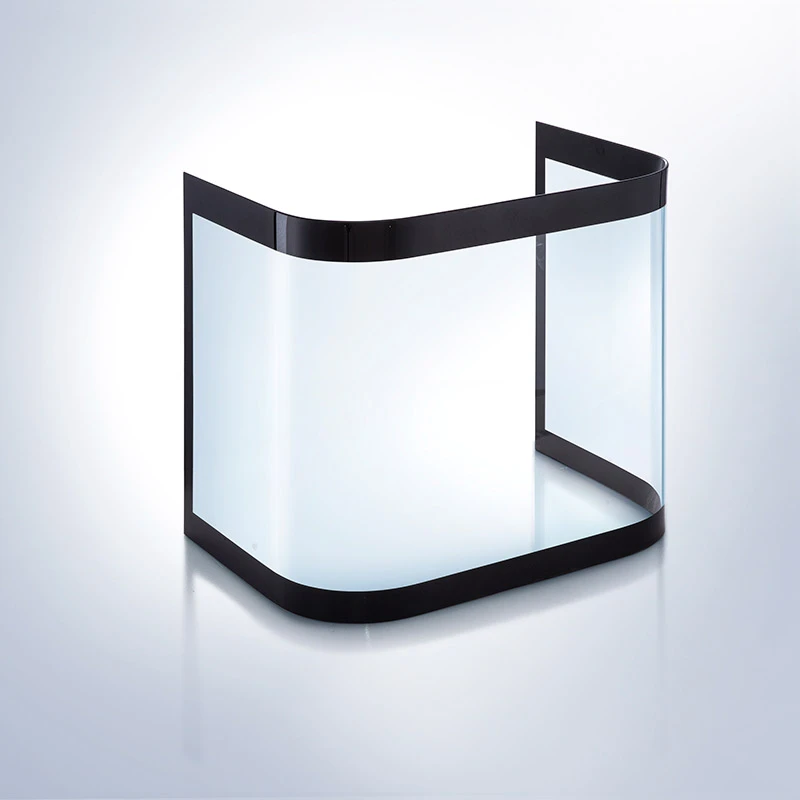
A correctly built IGU loses argon slowly. The commonly accepted benchmark is an annual loss of no more than one percentage point, which keeps a 95 percent fill above the 85 percent floor for years of service. Leakage concentrates in four places: permeation through the secondary seal, diffusion at the spacer-to-glass interface, corner joints of the spacer bar, and capillary tubes left unsealed after filling.
Two construction choices dominate retention. Dual sealing — a primary butyl seal behind the spacer and a structural silicone or polysulfide secondary seal — is mandatory for refrigeration duty. Warm-edge spacers reduce the stress differential at the edge and lower the permeation rate at the same time. A single-seal unit may test well on the day of filling and still fail a dew-point check within two summers.
| Method | Nature | What it verifies |
|---|---|---|
| Gas chromatography | Destructive, laboratory | Exact concentration, reference accuracy |
| Spark emission analyzer | Non-destructive, in-line | Fill level of every unit before packing |
| Dew-point test | Destructive sample | Seal integrity; dryness of the cavity |
| High-voltage spark seal test | Non-destructive sample | Continuity of the primary and secondary seals |
For order verification, the practical request is a spark-emission reading recorded per unit or per batch, backed by periodic destructive chromatography on production samples. A supplier that cannot produce either record is selling an unverified claim. Huayin runs automatic filling on a full insulated production line and issues fill verification with each order for its commercial supermarket freezer glass and freezer glass programs.
In a double-glazed freezer door, the Low-E coating belongs on surface 3 — the inner face of the outer pane's cavity side — so it reflects the far-infrared radiation coming from the cold interior back toward it. Filling that same cavity with argon cuts the conductive path, and the two measures compound rather than overlap.
Warm-edge spacers complete the assembly. They reduce the thermal bridge at the perimeter, which lowers the condensation risk on the inner surface near the edge — the region where freezer doors most often show the first frost line. Combined specifications for curved doors are covered under hot bent insulated heating glass.
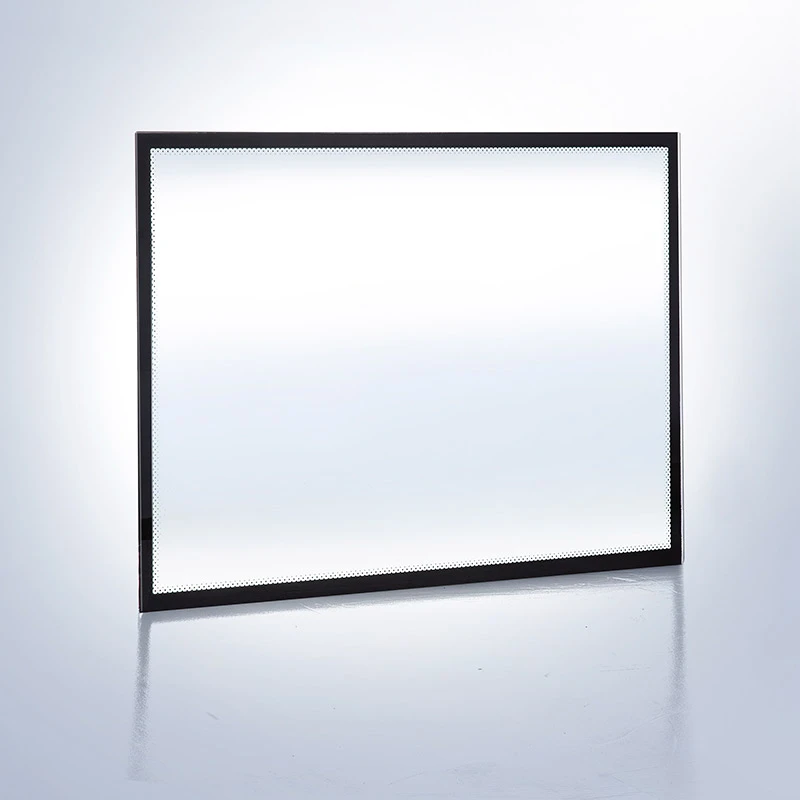
Argon only works inside a sealed cavity. Single-pane tempered doors gain nothing from any gas discussion, and in hot, humid climates the dominant field complaint is exterior condensation, which argon does not address — that belongs to heating design, covered in the ITO versus defogging coating comparison. For a tropical unconditioned store, sequence the budget as: insulated unit first, Low-E second, argon third, ITO heating where dew-point analysis demands it.
Items one through four are enough for an engineering review; omitting the verification method is the most common gap in first inquiries.
| Term | Definition |
|---|---|
| IGU | Insulated glass unit; two or more panes sealed into one assembly with a dry gas cavity |
| Fill concentration | Percentage of argon in the cavity gas at a stated point in time |
| Retention | Rate at which fill concentration declines in service, benchmarked under one point per year |
| Warm-edge spacer | Low-conductivity spacer bar that reduces the perimeter thermal bridge |
| Dew point | Temperature at which moisture in the cavity would condense; a seal-integrity indicator |
Q: Does argon stay in a curved IGU?
A: Yes, provided the unit is bent-tempered and assembled as a complete IGU with dual seals. Curvature does not change the retention physics; it changes the tooling, so curved heated units should be validated at sample stage before volume production.
Q: Should every door in a store be argon-filled?
A: Doors that open frequently lose energy through air exchange faster than through the glass, so the marginal value of argon is highest on closed merchandising doors and freezers with long door-closed cycles.
Huayin Glass Solutions manufactures insulated units with automatic filling and in-line verification in a 6,000+ square meter facility in Foshan, alongside wine cooler cabinet glass and curved tempered coated heated IG glass, certified to ISO 9001:2015 with exports to 50+ countries.
Send your door schedule and cavity specification for a fill-verified quotation: contact our engineering team.
Further reading: Manufacturing capability · Pastry display cabinet glass · Thermally bent glass series
Add:No. 16 Xingye Road, Beijiao Town Industrial Park, Shunde District, Foshan City, Guangdong Province
PHONE: +86 13509957538
TEL: +86 0757-26131933
Email: huayin_glass@163.com

© 2026 Huayin Glass Solutions All Rights Reserved.


