


 Add:No. 16 Xingye Road, Beijiao Town Industrial Park, Shunde District, Foshan City, Guangdong Province
 PHONE: +86 13509957538
 TEL: +86 0757-26131933
 Email: huayin_glass@163.com

Chinese


A retail chain replaced 60 freezer doors last winter. By July, eleven had fog between the panes, and the first supplier response was predictable: "the glass must have been damaged on site." It was not. Nine of the eleven carried the same furnace batch and the same seal lot. This article answers the six questions procurement teams ask when an insulated glass unit starts to fail, in the order the evidence usually appears.
The edge seal, almost every time. An insulated glass unit is not two panes with air between them: it is a spacer filled with desiccant, a primary seal of polyisobutylene that blocks vapour, and a secondary seal of polysulfide or silicone that carries structural load. The glass itself is the most durable part of the assembly.
When the primary seal is incomplete at a corner or the secondary seal flexes, moisture enters. The desiccant absorbs it until saturated, the dew point inside the cavity climbs, and condensation appears at the bottom edge first, then creeps inward in a band along the spacer. That is why a door can pass a dew point test at the factory and still fog within two seasons in a humid store.
Location and cleanability settle most cases. Moisture inside the cavity cannot be wiped away and always starts from the edge. A coating defect sits on a glass surface, often looks iridescent, and is usually uniform or patchy rather than edge-weighted.
Heated and touch-control doors add a third pattern: dark lines or green corrosion at the busbar and terminal. That is electrical, not thermal, and it normally follows a handling or soldering problem rather than a coating formula problem.
| Visible symptom | Likely failure | First check |
|---|---|---|
| Fog band along the bottom edge, inside | Primary seal breach, desiccant saturated | Dew point reading at three points |
| Grey or white deposit on the spacer face | Secondary seal chemical breakdown | Seal continuity at corners under raking light |
| Haze or rainbow tint on one surface | Coating damage during handling | Whether the mark sits on face 1 or 2 |
| Dark line at busbar or terminal | ITO busbar corrosion or cold solder joint | Resistance and insulation test |
| Fog appearing after a pressure wash | Frame or gasket path pushing water inward | Gasket compression and frame flatness |
Four do, and they account for a large share of premature claims. Over-clamped or twisted aluminium frames load the glass edge and crack the secondary seal within months. Self-tapping screws driven through the spacer to mount hinges or handles breach the vapour path outright. Gasket compression above roughly 50% transfers closing force into the glass edge. A blocked breather or drain lets pressure cycling pump humid air through the same seal.
None of these are visible on a glass inspection report, which is why the assembly drawing matters as much as the glass specification. Buyers who purchase the glass door and the frame from two suppliers inherit the argument between them.
Write these six items into the order, not into a side email. Each one maps to a failure mode above, and each one is cheap at the quotation stage and expensive afterwards.
| Parameter | Target to specify | Failure it prevents |
|---|---|---|
| Seal construction | Dual seal: PIB primary plus polysulfide or silicone secondary | Moisture ingress at corners |
| Spacer | Warm-edge profile with desiccant; pre-bent for curved doors | Edge condensation and stress cracking |
| Dew point at delivery | -40°C or below, tested per unit not per batch | Fogging within the first season |
| Gas fill | Argon 90% or higher when Low-E is used | Loss of the U-value you paid for |
| Edge deletion | 10-12 mm coating removal before assembly | Coating corrosion under the seal |
| Traceability | Furnace batch and assembly date on every label | Unprovable warranty claims |
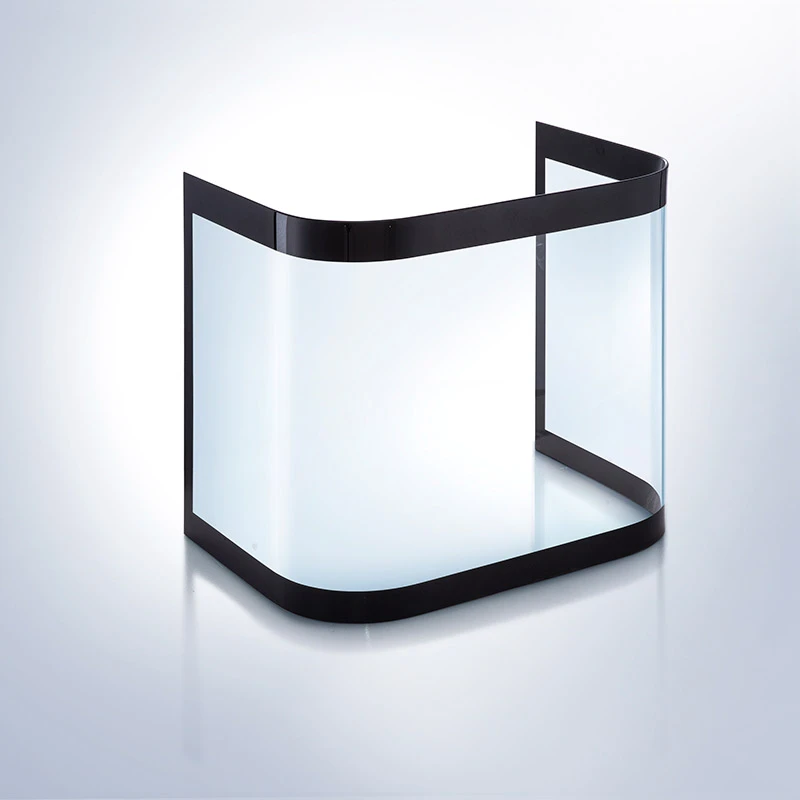
For curved doors, add one more: the spacer must follow the radius without buckling. A straight spacer forced into an R400 curve opens a gap on the inner face that no amount of sealant fills. Our curved tempered glass and coated curved anti-fog glass lines are built around that constraint.
On arrival: read the dew point with a meter at three points per unit, inspect the seal at all four corners under raking light, and photograph the batch label before the pallet is broken up. Fifteen minutes per shipment prevents most disputes later.
In the first 90 days: run the cabinet for thirty minutes, then scan the door edge with a thermal camera. An edge noticeably colder than the centre means the spacer or the frame is leaking heat, and it will be the first place to fog. Repeat the scan in the most humid month of the year, which is when a marginal seal gives up.
Classify before replacing. Seal failure, coating defect, handling damage and assembly error carry different responsibilities, and a claim that names the wrong one gets rejected on both sides. Send the batch label, dew point readings, installation date and site humidity together, in one package.
Batch traceability is what turns a shipment-wide replacement into a targeted one. When the furnace batch and seal lot are on the label, a supplier can isolate the affected units instead of asking the buyer to swap every door. Ask for that labelling system before the first order, because it cannot be reconstructed afterwards.
With one drawing and four numbers: door size, cabinet temperature, site humidity and the certification market. That is enough to fix the glass build-up, the spacer type and the seal class before any tooling is discussed. Send them to our engineering team for a drawing review within 24 hours.
Huayin Glass Solutions has been processing glass since 2002 in Shunde, Foshan, with 6,000+ m² of workshop space, ISO 9001:2015 and China CCC certification, exporting to more than 50 countries. Insulated units, heated doors, frames and gaskets are produced and assembled in one plant, so the seal that fails is the seal we made. See the manufacturing capabilities or browse the full product range.
Further reading: commercial supermarket freezer glass · wine cooler cabinet glass · hot bent insulated heating glass · ITO coating versus anti-fog coating
Add:No. 16 Xingye Road, Beijiao Town Industrial Park, Shunde District, Foshan City, Guangdong Province
PHONE: +86 13509957538
TEL: +86 0757-26131933
Email: huayin_glass@163.com

© 2026 Huayin Glass Solutions All Rights Reserved.


