


 Add:No. 16 Xingye Road, Beijiao Town Industrial Park, Shunde District, Foshan City, Guangdong Province
 PHONE: +86 13509957538
 TEL: +86 0757-26131933
 Email: huayin_glass@163.com

Chinese


A beverage appliance brand recently sent us a competitor's spec sheet and asked one question: "Why does this wine cooler glass door cost more than ours — and which of these features do we actually need?" It is the right question, because wine cooler door technology has moved fast in the last three years. Below, each trend is answered as a standalone question, in the order buyers usually meet them.
Because compressors are getting smaller while customer expectations for energy labels keep rising. A Low-E coated pane reflects infrared radiation back toward the wine chamber, which cuts heat gain through the door and lets the cooling system cycle less often.
In dual-zone coolers the effect is bigger: the coated surface sits on face 3 of the insulated glass unit, separating the warm room side from the chilled cellar side. Buyers now routinely specify Low-E + argon as the baseline configuration rather than an upgrade, and our wine cooler cabinet glass line reflects that shift.
Double glazing still dominates volume production because it hits the cost-performance sweet spot for 5-18°C storage. Triple pane is reserved for built-in luxury units, long-term aging cabinets and markets with strict energy regulations.
| Configuration | Typical use | Cost and weight |
|---|---|---|
| Double pane, argon, Low-E | Standard freestanding coolers | Baseline cost, moderate weight |
| Triple pane, argon, dual Low-E | Built-in and aging cabinets | Higher cost, +30-40% weight |
| Double pane + heated outer pane | Humid climates, high door-open duty | Adds ITO coating and busbar process |
For curved or bent doors, the same logic applies through hot bent insulated heating glass, where the IGU is formed to the door radius instead of pressed flat.
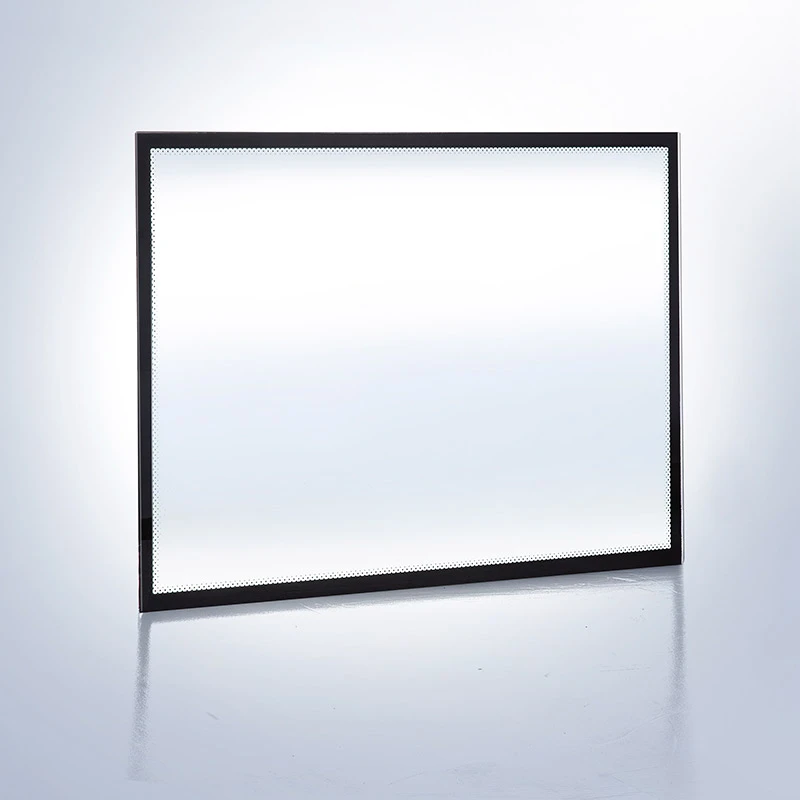
It matters more than most buyers expect. UV radiation degrades tannins and accelerates aging, which is why serious storage cabinets specify laminated or UV-filtering coated glass with transmission below 1% in the 300-380nm band.
The trade-off is tint. A strong UV filter usually shifts visible transmission and color rendering, so the door shows the labels less attractively. The workable compromise used in current designs is a neutral Low-E stack on an ITO heated coated IGU: UV rejection without the amber cast of older laminated solutions. Ask any prospective supplier for the spectral transmission curve, not just a "UV protection" claim.
Three changes are visible in current OEM projects. First, capacitive touch panels are being integrated into the glass itself, replacing plastic bezel buttons; our touch control glass door for wine coolers is a typical result. Second, hidden temperature displays sit behind smoked glass zones printed during screen printing, so the panel reads clean until lit. Third, perimeter LED light strips are now part of the door spec rather than the cabinet spec, which changes how the glass edge must be finished.
All three trends push more processing into the door: printing zones, slotting for sensors, and connector channels. That is why door-level engineering capacity matters when you choose a supplier.
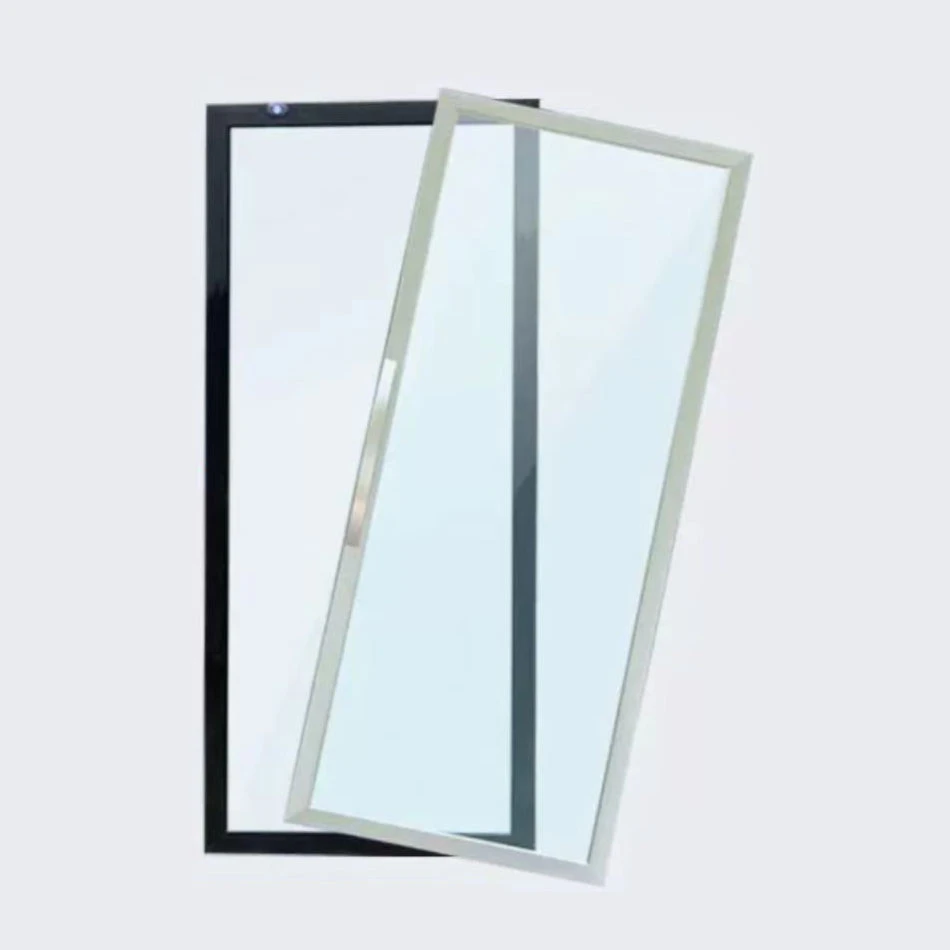
Four checks keep a trend-driven spec deliverable. Verify the coating position is stated on the drawing (face 2 or face 3), because it changes performance more than the coating brand. Verify argon fill concentration is quoted as a number, not as "argon filled". Verify tempered safety compliance to the target market's standard, with fragmentation reports available per batch. And confirm the supplier controls the full door assembly — glass, frame, gasket, hinge — so tolerances do not drift between vendors; our glass door series and client projects show how a single-source assembly is documented.
Start with a one-page brief: door dimensions and radius, pane configuration, UV and Low-E requirements, display or touch features, annual volume. Engineers can then return a DFM assessment and a sample plan before any tooling is committed.
Huayin Glass Solutions (Huayin Glass Craft Factory) was founded in 2002 in Beijiao, Shunde, Foshan, Guangdong — next to Beijiao Port, Nansha Port and Huangpu Port. With a 6,000+ m² factory, ISO 9001:2015 certification, China 3C certification and in-house ITO coating, low-E coating, argon filling and curved tempering lines, the company exports custom glass doors to 50+ countries. Learn more on about us and manufacturing capabilities.
Send your drawing for a free DFM review and OEM quotation.
Further reading: ITO glass vs anti-fog coating · Featured projects · All products
Add:No. 16 Xingye Road, Beijiao Town Industrial Park, Shunde District, Foshan City, Guangdong Province
PHONE: +86 13509957538
TEL: +86 0757-26131933
Email: huayin_glass@163.com

© 2026 Huayin Glass Solutions All Rights Reserved.


