


 Add:No. 16 Xingye Road, Beijiao Town Industrial Park, Shunde District, Foshan City, Guangdong Province
 PHONE: +86 13509957538
 TEL: +86 0757-26131933
 Email: huayin_glass@163.com

Chinese


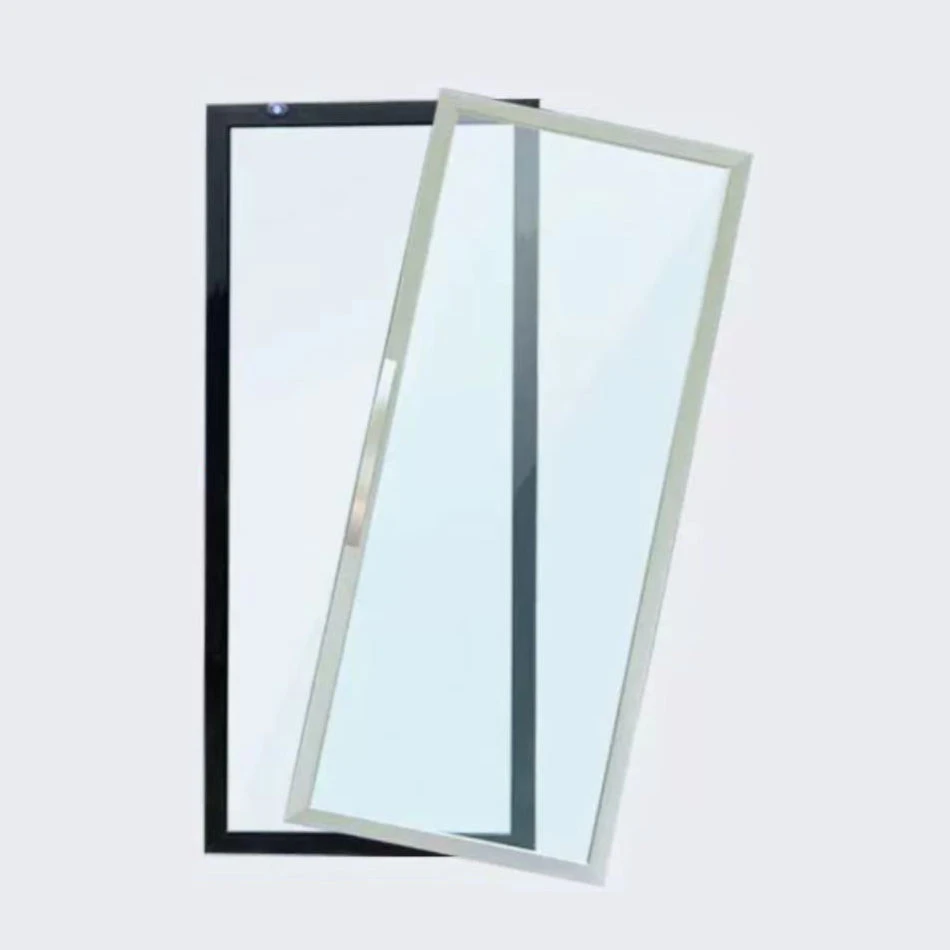
Stepped-edge insulated glass is an insulated glass unit in which the outer pane extends beyond the inner pane, creating a step that seats inside the door frame. It is the standard build for commercial freezer doors where the frame must cover the spacer line while the inner face stays flush with the cabinet interior. This brief sets out the six specification areas that decide whether a stepped unit fits, seals, and performs in service: edge geometry, glass build, coating, spacer and gas fill, frame interface, and testing.
In a stepped unit, the outer pane is cut oversize relative to the inner pane before tempering. After assembly, the exposed strip of the outer pane — commonly called the flange — is the portion that enters the frame slot. Step height, the offset between the two pane edges, is the single dimension most often under-specified in first-time inquiries.
The step is produced at cutting and edging stage, then locked in permanently by the tempering and insulating sequence. It cannot be adjusted after the unit is sealed, so step dimensions must be confirmed against the frame drawing before production starts.
Edge offset should be held within ±1.5 mm; larger variation shows up as an uneven glass line around the door perimeter once the frame cover is fitted. Where the door design is rounded, the corner radius must match both the bending die and the light channel of the frame.
| Parameter | Typical project range | Why it matters |
|---|---|---|
| Step height (outer vs inner pane offset) | 10-30 mm | Determines frame cover and insertion depth |
| Unit thickness, double build | 22-32 mm | Frame slot width and gasket compression |
| Edge offset tolerance | ±1.5 mm | Uneven steps show as a visible glass line in the frame |
| Corner radius (rounded doors) | R50-R150 mm | Must match door die and light channel |
| Edge work | Flat ground or polished | Chip-free edges reduce gasket wear and seal risk |
Build selection follows cabinet duty. The table below maps common builds to applications; all panes are tempered, and heat soak testing is available for projects where nickel sulfide risk must be minimized.
| Build | Typical application | Thermal role | Cost position |
|---|---|---|---|
| Double, clear panes | Beverage coolers, mild-duty display | Baseline insulation | Baseline |
| Double, Low-E + argon | Supermarket freezer doors | Lower U-value, better humidity control | Moderate |
| Triple, Low-E + argon | Island and chest freezers at -18°C and below | Lowest heat gain in high-ambient stores | Higher |
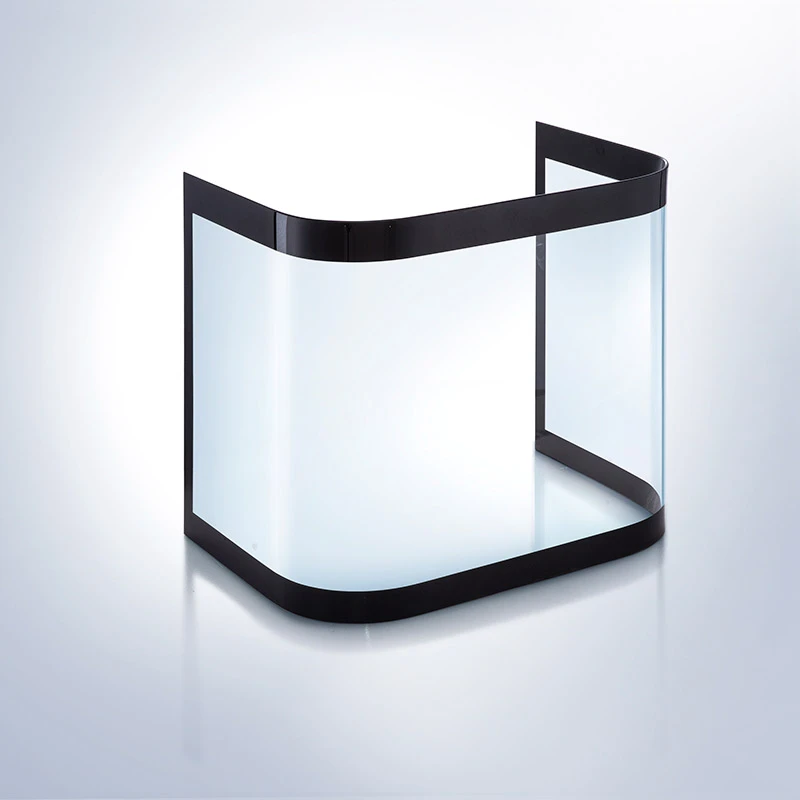
| Curved stepped unit | Cake display and curved door designs | Matches double or triple thermal build | Project-based |
Double builds remain the volume standard for cooler and freezer glass lines. Triple builds earn their cost in deep-freeze cabinets and in stores with high ambient humidity, where the extra cavity delays inner-pane condensation.
Low-E is normally specified on the cavity-facing surface of the outer pane — surface 2 in a double build. Placing the coating on surface 3 trades a small change in thermal performance for different condensation behaviour at the inner light. Confirm which surface the door engineer's U-value calculation assumes before ordering; a mismatch here is invisible at delivery and only appears in the field.
High-humidity stores pair the stepped build with an ITO heated outer pane. The coating is fired into the glass before tempering, so the heating design must be fixed at the same time as the step geometry. The trade-offs between heated glass and applied coatings are covered in our ITO versus defogging coating comparison; combined heated insulated builds are shown under hot bent insulated heating glass.
A warm-edge spacer lowers conductivity at the perimeter and reduces the cold ring that appears around the frame in freezer duty. Aluminum spacers remain available where the frame design already isolates the edge.
Argon fill is standard on Low-E builds; it lowers conductance across the cavity and steadies the inner-pane temperature. The edge seal is a dual-seal system — primary seal for moisture barrier, secondary seal for structural strength — with desiccant inside the spacer to hold the cavity dry over the unit's life. This is the same seal architecture used on our refrigerator glass doors.
The step must enter the frame slot deep enough that the gasket compresses uniformly along its length. Shallow insertion lets the unit ride out under repeated door slam and shows up first as a corner leak. On anodized aluminum frame doors, the frame slot tolerance should be reviewed together with the unit drawing.
Gasket material and compression range belong in the specification, not as an afterthought. Compression held between 15-30% keeps the seal elastic; over-compression creeps over time, under-compression leaks. Magnetic gaskets add door-closing force on reach-in cabinets — see the magnetic door gasket page for profiles.
| Item | Typical value | Note |
|---|---|---|
| Insertion depth of step into frame | 8-15 mm | Too shallow lets the unit ride out under door slam |
| Gasket compression | 15-30% | Over-compression creeps; under-compression leaks |
| Setting blocks | Per door design | Prevent glass-to-metal contact at the frame bottom |
| Drainage path | Frame weep holes | Keeps the seal line dry on washed-down cabinets |
Supplying the first three items is usually enough for an engineering review; the frame drawing closes most of the remaining questions.
| Term | Definition |
|---|---|
| Stepped edge (flange) | Extended outer-pane edge that seats inside the door frame slot |
| IGU | Insulated glass unit; two or more panes sealed around a dry cavity |
| U-value | Rate of heat transfer through the unit per unit area and temperature difference |
| Warm-edge spacer | Low-conductivity spacer that reduces heat loss around the perimeter |
| Dual seal | Primary moisture seal plus secondary structural seal at the unit edge |
| Argon fill | Inert gas in the cavity that lowers conductance versus air |
| ITO | Indium Tin Oxide; transparent conductive coating used as a heating layer |
Q: Can a stepped edge be combined with curved glass?
A: Yes. Hot-bent tempered stepped units are routine for cake display and curved door projects; curvature, step geometry, and the frame light channel should be evaluated together at sample stage. Curved builds are shown under curved tempered glass.
Q: Why does a visible glass line appear around the finished door?
A: Usually uneven step height or a frame cover that is too shallow. Specify the edge offset tolerance and share the frame drawing before production; both are one-line fixes at the drawing stage and rework items afterwards.
Huayin Glass Solutions produces stepped and flat insulated builds for wine cooler cabinet glass and pastry display cabinet glass, alongside flat commercial supermarket freezer glass. Manufacturing covers cutting, edging, tempering, insulating, and door assembly within a 6,000+ square meter facility in Foshan, Guangdong — see manufacturing capability. Certified to ISO 9001:2015 and China CCC, with exports to 50+ countries.
Send your door drawings and target U-value for a build assessment: contact our engineering team.
Further reading: Featured projects · Products · ITO vs defogging coating comparison
Add:No. 16 Xingye Road, Beijiao Town Industrial Park, Shunde District, Foshan City, Guangdong Province
PHONE: +86 13509957538
TEL: +86 0757-26131933
Email: huayin_glass@163.com

© 2026 Huayin Glass Solutions All Rights Reserved.


