


 Add:No. 16 Xingye Road, Beijiao Town Industrial Park, Shunde District, Foshan City, Guangdong Province
 PHONE: +86 13509957538
 TEL: +86 0757-26131933
 Email: huayin_glass@163.com

Chinese


Walk through the frozen food aisle of a convenience store in the Gulf and the island freezers are impossible to miss: chest-type cabinets lined up in the center of the floor, lids wide open, cold air pouring over the edge into a 40°C sales room. Shoppers reach in across the open top, dust settles on the frozen packs, and the compressor underneath runs almost without pause. For one retail group operating 46 stores across the region, this was the daily reality at 260 open-top island freezer positions.
Open tops are cheap to build and fast to shop from, but they are also the least efficient way to hold -18°C in a hot climate. The group's facilities team decided to close the tops without replacing the cabinets — a retrofit built around track-mounted sliding glass doors from a China-based glass processing factory, and they treated it as a measurable engineering project rather than a one-off purchase.
Before issuing any tender, the facilities team spent a summer month measuring conditions across a sample of 12 stores. Compressor duty cycle on the open-top islands ran visibly longer than on closed vertical cabinets in the same stores. Store staff reported repacking frosted, freezer-burned product several times a week — product that had to be written down or returned. And every cabinet top collected dust and spillage overnight, adding a nightly cleaning task the stores had never budgeted for.
None of these numbers appear on a quotation sheet, but together they defined the project in one sentence: keep the cabinets, close the tops, and do it without rewriting the store layout or shutting any freezer down for more than a day.
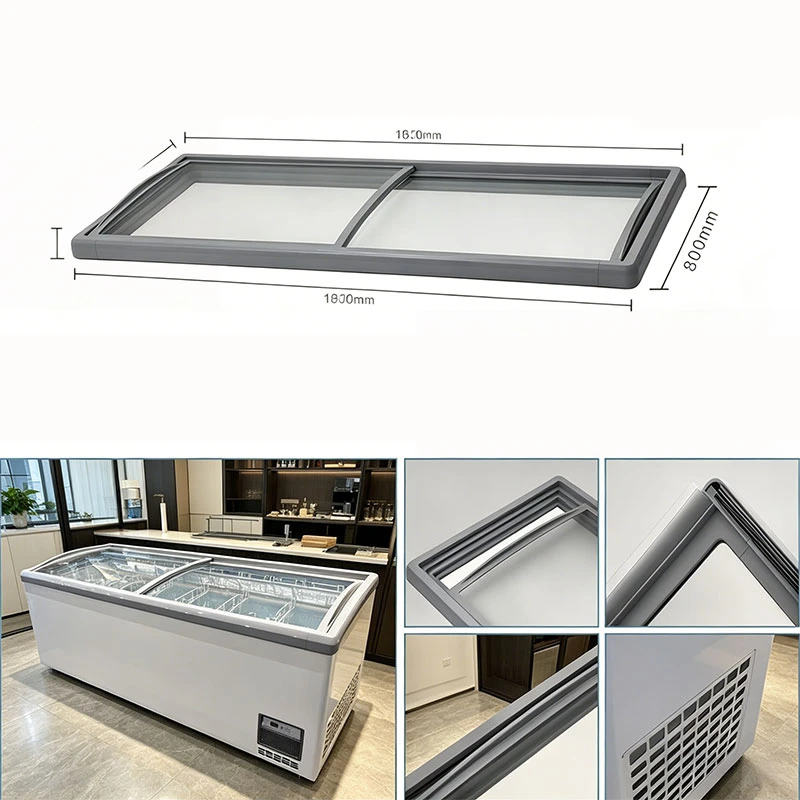
Because the existing cabinets were staying, every dimension started from the current top rim. The team wrote the measurements into a purchasing specification and sent it to three suppliers.
| Requirement | Target | Reason |
|---|---|---|
| Mounting | Clamp-on aluminum track, no welding or drilling into cabinet body | Cabinets stay in service during conversion |
| Glass build-up | Insulated double glazing on -18°C islands; 6 mm tempered single glass on chilled islands | Match thermal performance to each temperature zone |
| Condensation | No visible fog at 75% RH and 38°C ambient | Coastal summer humidity in the region |
| Glide | Smooth one-hand slide on nylon rolling carriers | Staff open lids hundreds of times per shift |
| Hygiene | Flush track profile, removable for cleaning | Fast nightly wipe-down, food-safe surfaces |
| Lead time | ≤ 35 days per batch | Roll out store by store without disruption |
The group awarded the project to the one supplier that quoted the aluminum track system and the glass doors as matched assemblies rather than two separate products — a difference that showed up later in the glide and sealing results.
Sliding doors live or die on their track. The selected system uses anodized aluminum profiles with a flush, removable lower rail and nylon rolling carriers sized to the door weight — a critical detail because the double-glazed lids weigh over 40% more than single-pane versions. Undersized carriers are the most common cause of sagging doors in this product category.
Frozen-food islands at -18°C received insulated double-glazed lids with a warm-edge spacer, while chilled display islands received 6 mm toughened single glass — the specification resisted the temptation to standardize on the most expensive option everywhere. For buyers comparing glazing options, the commercial grades behind freezer glass and commercial supermarket freezer glass cover the same temperature-zone logic used here.
Each lid closes against a magnetic gasket seated in the track profile, keeping the seal in compression when the door parks — the same principle used on magnetic door gaskets for vertical cabinets. Doors were specified to stack over each other at the fully open position so the shopping aperture stays unobstructed.
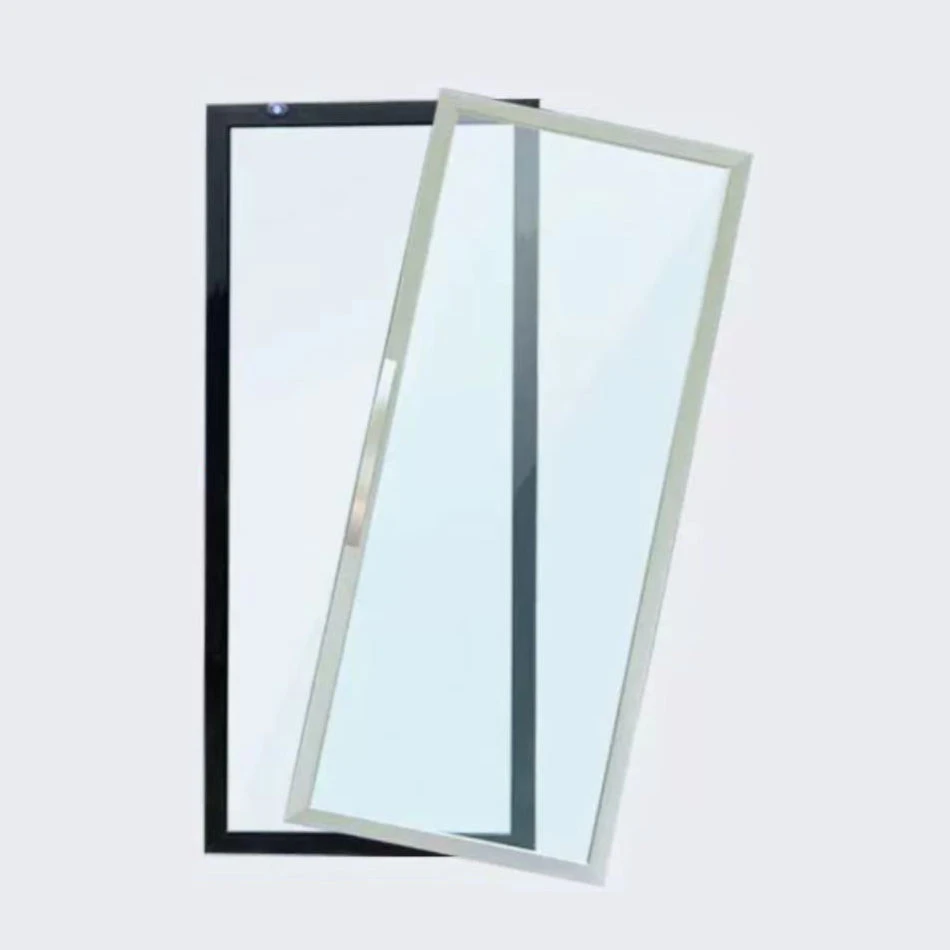
Twelve prototype lids went into four stores chosen for the worst humidity exposure and heaviest customer traffic, and ran for eight weeks. Validation covered four checkpoints: glide force after dust exposure, fog-free performance at peak humidity, gasket integrity after repeated open-close cycles, and track alignment on cabinets whose rims were not perfectly level.
The sampling stage earned its calendar time. On the heaviest double-glazed lids, the original carrier material showed accelerated wear after six weeks; the carrier was upgraded before mass production, a change that would have been prohibitively expensive to make after 260 units shipped.
Two quarters after completing the rollout across all 46 stores, the group reported the following directional outcomes on converted islands.
| Metric | Direction of change |
|---|---|
| Cold air spillage during closed hours | Eliminated on converted islands |
| Compressor duty cycle | Reduced versus the open-top baseline |
| Frost and freezer-burn repacking | Sharply down across sample stores |
| Nightly cleaning of cabinet tops | Faster — closed, wipeable surface |
| Customer complaints about frosted packaging | Effectively stopped |
Absolute savings varied with cabinet age and store climate, which is why the team reported direction rather than a single headline number. Buyers planning a similar conversion should log their own compressor and repacking baselines before quoting payback periods.
Q: Should every island freezer get insulated glass lids?
A: No. The chilled islands in this project run single toughened glass and perform as intended. Matching the glazing to the temperature zone controlled cost without sacrificing the frozen-food result.
Q: What single detail mattered most in the retrofit?
A: The track-and-gasket interface. Glass quality is visible on day one; track profile tolerances and carrier ratings only show up months later as sagging doors and leaking seals.
The broader lesson: measure first, write the numbers into the specification, then source against that specification — the same discipline the group applied here, supported by a factory whose manufacturing capability covers CNC cutting, tempering, insulated assembly, and aluminum track fabrication under one roof.
Planning an island freezer conversion? Send your cabinet rim dimensions and temperature zones to our engineering team for a free DFM assessment and sample quotation.
Further reading: ITO glass vs defogging coating · Featured projects · Client cases
Add:No. 16 Xingye Road, Beijiao Town Industrial Park, Shunde District, Foshan City, Guangdong Province
PHONE: +86 13509957538
TEL: +86 0757-26131933
Email: huayin_glass@163.com

© 2026 Huayin Glass Solutions All Rights Reserved.


