


 Add:No. 16 Xingye Road, Beijiao Town Industrial Park, Shunde District, Foshan City, Guangdong Province
 PHONE: +86 13509957538
 TEL: +86 0757-26131933
 Email: huayin_glass@163.com

Chinese


Last quarter a European beverage brand came to us with a problem. Their new curved-door upright freezer looked great in the showroom, but after two doors cracked in transit, the insurer required laminated glass — and nobody on the project was sure a curved door could also be laminated.
The answer is yes. The process is called hot bent laminated glass, and it is increasingly specified for curved freezer doors, bakery cases and premium display cabinets. Below are the six questions buyers ask most, answered in the order they usually come up.
Hot bent laminated glass is curved glass in which two or more sheets are bent to the same curvature and bonded with a PVB or EVA interlayer in one controlled process. If the pane breaks, the shards stay held by the interlayer instead of scattering across an aisle.
That single property changes the risk profile of a door: fewer injury claims, no glass rain over open food, and often a door that stays in its frame until a planned replacement. The product sits within our thermally bent glass family, next to curved tempered and hot bent insulated options — and the dedicated line is hot bent laminated glass.
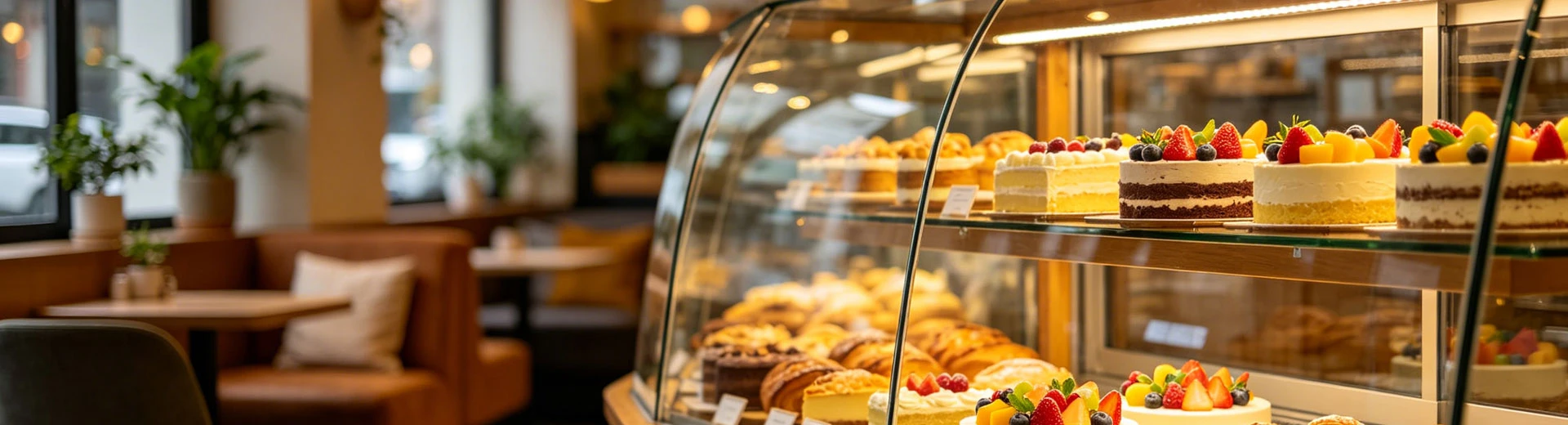
Curved tempered glass is the default for commercial freezer doors — strong, cost-efficient, and safe in its own way, breaking into small blunt pieces. Laminated curved glass adds post-breakage integrity, which matters in high-traffic aisles, over open food, or wherever an insurer or retail chain demands it.
| Aspect | Curved tempered glass | Hot bent laminated glass |
|---|---|---|
| Breakage behaviour | Small blunt fragments | Shards held by interlayer |
| Door after breakage | Integrity lost, immediate replacement | Usually stays in frame until planned swap |
| Security / vandalism resistance | Moderate | Higher |
| Food-safety exposure | Fragments may reach products | Interlayer contains fragments |
| Cost | Lower | Higher (interlayer + matched process) |
A practical rule: keep curved tempered glass for standard doors, and switch to laminated where a breakage would stop trading — flagship stores, overhead-glazed cases, or chains with strict internal safety codes.
Standard PVB performs well across most commercial refrigeration temperatures. For doors that spend years below -15°C, interlayer selection and edge quality matter more: low-temperature PVB or EVA systems resist cold-induced delamination better, and well-sealed edges keep moisture out of the sandwich.
Before quoting, we confirm the real door temperature and duty cycle rather than assuming from a datasheet. The same review decides whether the door also needs heating — see hot bent insulated heating glass and coated curved tempered anti-fog glass for the two common heated routes.
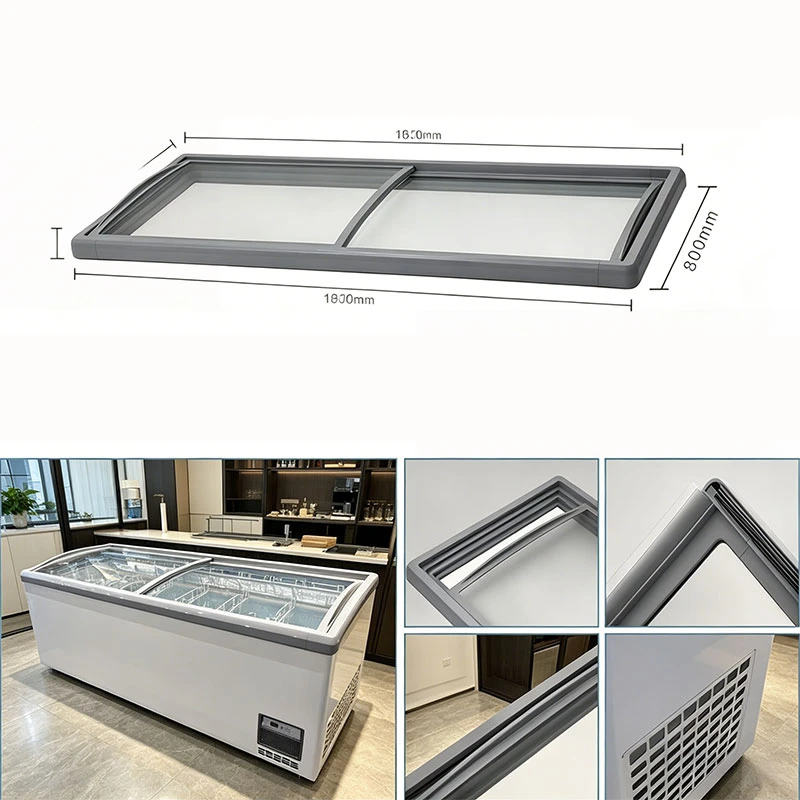
Bending sets the curvature; laminating then demands that both sheets match within tight tolerance so the interlayer bonds without optical distortion. In practice this means matched moulds, controlled heating curves, and inspection against a 1:1 template.
The acceptance numbers are simple to agree upfront: arc fit within about ±1 mm against the template, and no visible ripple when the pane is viewed from the side. Put both in the purchase contract, not in an email thread.
A usable quote starts from data, not photos: curvature source (chord and sagitta, or a 1:1 template), glass make-up with thickness and interlayer type, edgework and holes, defog or heating options, and packing designed for long sea freight.
Ask for test data with the offer — tempering certificates, optical inspection results, and low-temperature cycling where relevant. You can benchmark a supplier's depth on the manufacturing page and delivery records under clients; a supplier who quotes from a photo alone is delegating the surprises to your installation team.
With a drawing and the door's working temperature. Send the curvature parameters, intended glass make-up, environment (freezer or cooler), and expected annual volume; our engineers return a DFM review with a recommended interlayer system and a sample plan.
Huayin Glass Solutions has manufactured custom bent and laminated glass in Shunde, Foshan, Guangdong since 2002 — a 6,000+ m² factory, ISO 9001:2015 and China 3C certified, exporting to 50+ countries. Hot bent laminated glass is a standard custom line here, not a special favour. Send your drawing for a free DFM review and sample quote.
Further reading: Featured Projects · Freezer Glass · ITO Heated Glass vs Defog Coating
Add:No. 16 Xingye Road, Beijiao Town Industrial Park, Shunde District, Foshan City, Guangdong Province
PHONE: +86 13509957538
TEL: +86 0757-26131933
Email: huayin_glass@163.com

© 2026 Huayin Glass Solutions All Rights Reserved.


