


 Add:No. 16 Xingye Road, Beijiao Town Industrial Park, Shunde District, Foshan City, Guangdong Province
 PHONE: +86 13509957538
 TEL: +86 0757-26131933
 Email: huayin_glass@163.com

Chinese


A mid-sized bakery equipment importer in Central Europe had been sourcing cake cabinet curved glass from a local fabricator for years. When that supplier retired in early 2026, they faced a choice: find another European fabricator at roughly double the cost, or explore custom glass manufacturing in China. This case study follows their decision, their validation process, and what happened after the first containers arrived.
Their product line covers three cabinet sizes — 900mm, 1200mm, and 1500mm display cases — each with a curved front door, a fixed curved back panel, and a flat top glass. The curved sections require tight radius control (R400–R600), uniform optical quality for product visibility, and consistent dimensional fit into aluminum extrusion frames that the importer manufactures locally. Any deviation in radius or edge profile means rework or scrap at the assembly stage.
The importer's previous supplier had handled everything from mold making to final inspection. Their retirement left not just a capacity gap, but a knowledge gap — no drawings, no mold files, only physical samples of the three door sizes. The importer's engineering team had to reverse-engineer the specifications before they could even request quotes from new suppliers.
They evaluated three options: a German fabricator (quoted 2.3× the previous price, 14-week lead time), a Polish supplier (quoted 1.6×, 10-week lead time, but no hot-bending capability — only cold-bent laminated), and a Chinese glass deep-processing factory with integrated hot-bending and tempering (quoted at the previous price level, 6-week lead time). The decision to sample from China was driven by capability match and cost structure, not just price.
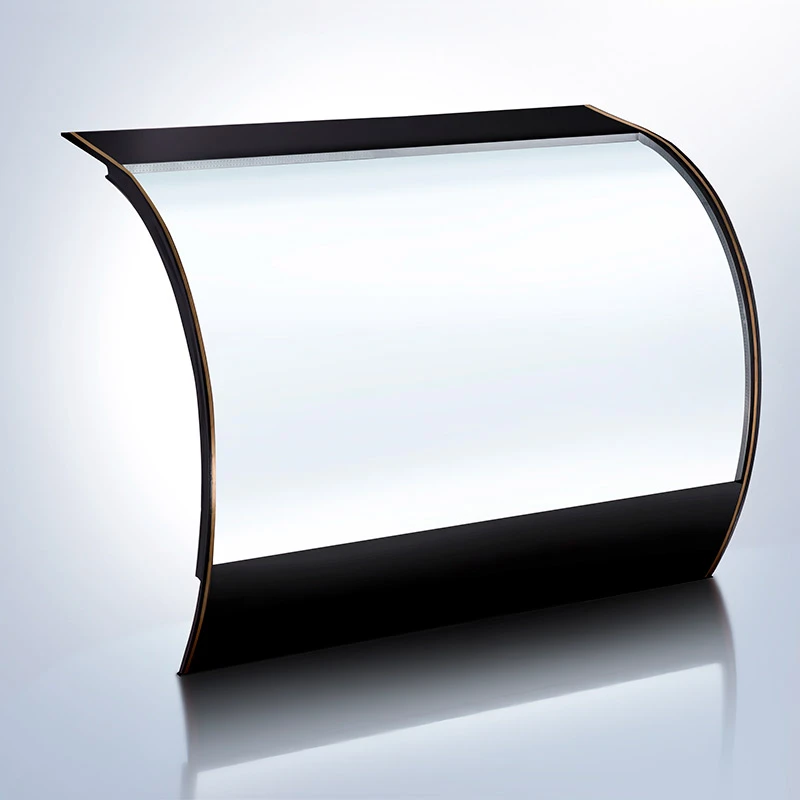
With no digital drawings available, the team measured every dimension on physical samples and compiled a specification sheet. The critical dimensions were radius, chord length, arc height, edge profile, and thickness — all of which had to fit the existing aluminum frames without modification.
| Requirement | Target | Reason |
|---|---|---|
| Radius tolerance | ±2 mm | Fit existing aluminum frame groove |
| Thickness | 4 mm + 0.2 mm / –0.1 mm | Match gasket compression design |
| Edge profile | Stepped edge, polished | Fit frame gasket channel |
| Optical distortion | ≤0.3 mm/300 mm | Product visibility for display |
| Tempering | Full tempered, EN 12150 | Safety compliance for EU market |
| Surface quality | No visible roller wave | Cosmetic standard for retail display |
The selected configuration was mold-pressed hot-bent tempered glass with a stepped edge profile. Mold pressing was chosen over gravity bending because the radius range (R400–R600) and thickness (4 mm) demanded tighter dimensional control than gravity bending typically delivers.
The factory produced three mold sets based on the importer's physical samples. Mold ownership was transferred to the importer after final approval, meaning they could move production to another facility if needed — a risk-mitigation clause the importer insisted on.
Annealed hot-bent glass would have been easier to produce and cheaper, but EU retail equipment safety standards effectively require tempered glass for customer-facing display cabinets. The tempering step adds thermal stress that must be carefully controlled after bending to avoid optical distortion.
Curved glass is vulnerable to point-contact damage during shipping. The factory designed custom plywood crates with foam contour inserts that matched each radius, eliminating movement during sea freight. This detail, often overlooked in sourcing negotiations, proved critical — zero breakage across three containers.
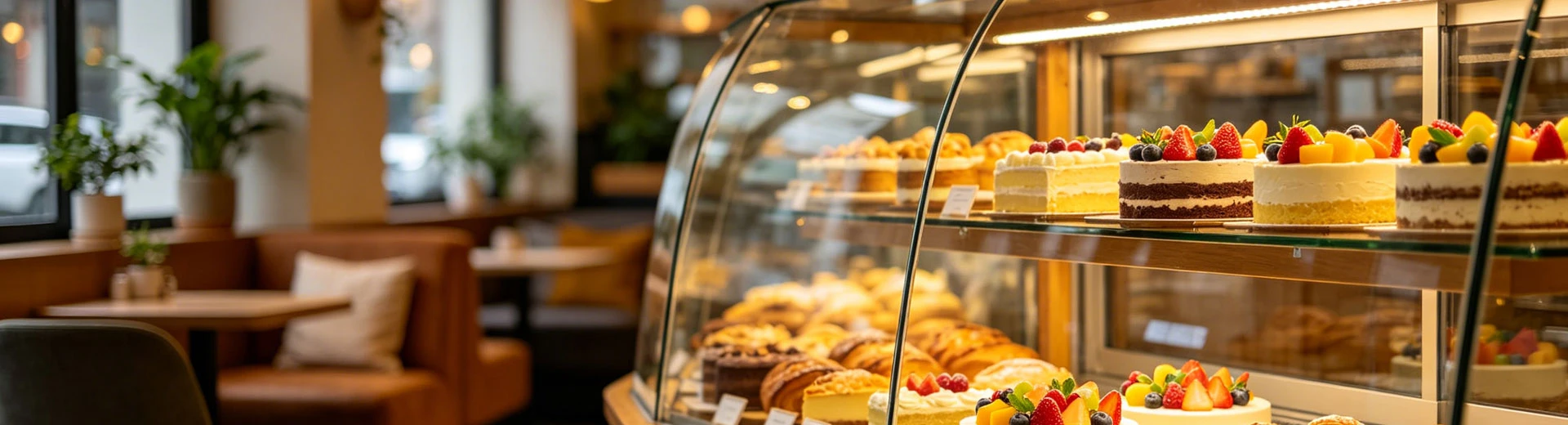
The importer requested five sample pieces per size (15 total) before approving mass production. Samples were evaluated in three stages: dimensional inspection at the factory, fit testing in the importer's aluminum frames, and a 30-day display trial in a working cabinet.
Dimensional inspection used a coordinate measuring arm to verify radius, chord length, and edge profile against the specification. One sample from the first mold showed a radius deviation of +3.2 mm — outside tolerance. The mold was adjusted and re-sampled. The second round passed all dimensions. Fit testing confirmed gasket channel engagement and door swing clearance. The display trial monitored for fogging, condensation patterns, and customer visibility — all passed.
The first production order covered 320 curved glass pieces across the three sizes, shipped in two batches. After assembly and rollout to the importer's distribution network, the following outcomes were tracked.
| Metric | Result |
|---|---|
| Dimensional first-pass yield | 97.2% (311/320 within tolerance) |
| Transit breakage | 0 pieces (custom crate design) |
| Assembly fit complaints | 3 pieces (edge profile edge case, corrected in batch 2) |
| Customer visibility feedback | No optical distortion complaints |
| Lead time vs. previous supplier | 6 weeks vs. 8 weeks (local) |
The 9 pieces outside tolerance were re-cut and re-bent at the factory's expense under the agreed quality clause. The importer noted that their previous local supplier had also run a 3–5% rework rate, so the 97.2% first-pass yield was within expected range.
Q: Is mold-pressed hot-bent glass always better than gravity-bent?
A: Not always. For large radii (R≥1000 mm) and thin glass (≤3 mm), gravity bending is often sufficient and more cost-effective. Mold pressing adds precision but also mold cost. Match the process to the tolerance requirements, not to the maximum capability.
Q: How critical is the sampling stage for curved glass?
A: Critical. Radius and edge profile are not easily corrected after production. The sampling stage caught a mold deviation that would have affected the full order. Budget 3–4 weeks for sampling and validation.
The broader lesson: when switching suppliers for custom curved glass, invest in precise dimensional specification and physical sample validation before committing to mass production. Huayin Glass manufacturing capability covers the full chain from CNC cutting to mold-pressed hot bending, tempering, and custom packaging — which is what allowed this project to meet both the dimensional requirements and the transit durability standards.
Planning a curved glass OEM project? Send your drawings or physical samples to our engineering team for a free DFM assessment and sample quotation.
Further reading: ITO glass vs defogging coating · Featured projects · Pastry display cabinet glass
Add:No. 16 Xingye Road, Beijiao Town Industrial Park, Shunde District, Foshan City, Guangdong Province
PHONE: +86 13509957538
TEL: +86 0757-26131933
Email: huayin_glass@163.com

© 2026 Huayin Glass Solutions All Rights Reserved.


