


 Add:No. 16 Xingye Road, Beijiao Town Industrial Park, Shunde District, Foshan City, Guangdong Province
 PHONE: +86 13509957538
 TEL: +86 0757-26131933
 Email: huayin_glass@163.com

Chinese


Foggy freezer doors are one of the fastest ways to ruin product visibility and increase energy bills. Buyers sourcing freezer glass doors from China often see "ITO heated glass" listed as a premium option, but the technology behind it is rarely explained in plain terms. Below we answer the most common questions buyers ask a commercial freezer glass supplier before placing an OEM order.
ITO stands for Indium Tin Oxide, a transparent conductive oxide that can be deposited as a thin film on glass. When an electric current passes through the film, it generates heat across the glass surface. In commercial supermarket freezer glass, this heat keeps the door surface above the dew point, preventing condensation without blocking light.
Passive anti-fog coatings work by absorbing moisture, but they saturate quickly in high-traffic stores and lose effectiveness over time. Active ITO heating solves the root cause: it stops water vapor from condensing in the first place. That is why most premium display freezers, wine coolers, and pastry cabinets specify ITO-heated doors.
The principle is simple: electrical resistance in the ITO film converts current into uniform heat. Bus bars printed along the edges of the glass distribute power evenly. A controller regulates the temperature so the surface stays warm enough to prevent fog without overheating the cabinet interior.
Film quality matters. A uniform layer gives consistent heating; pinholes or thickness variation create cold spots where fog still forms. Huayin Glass uses magnetron sputtering equipment to control film thickness within tight tolerances, ensuring stable resistance across the whole pane.
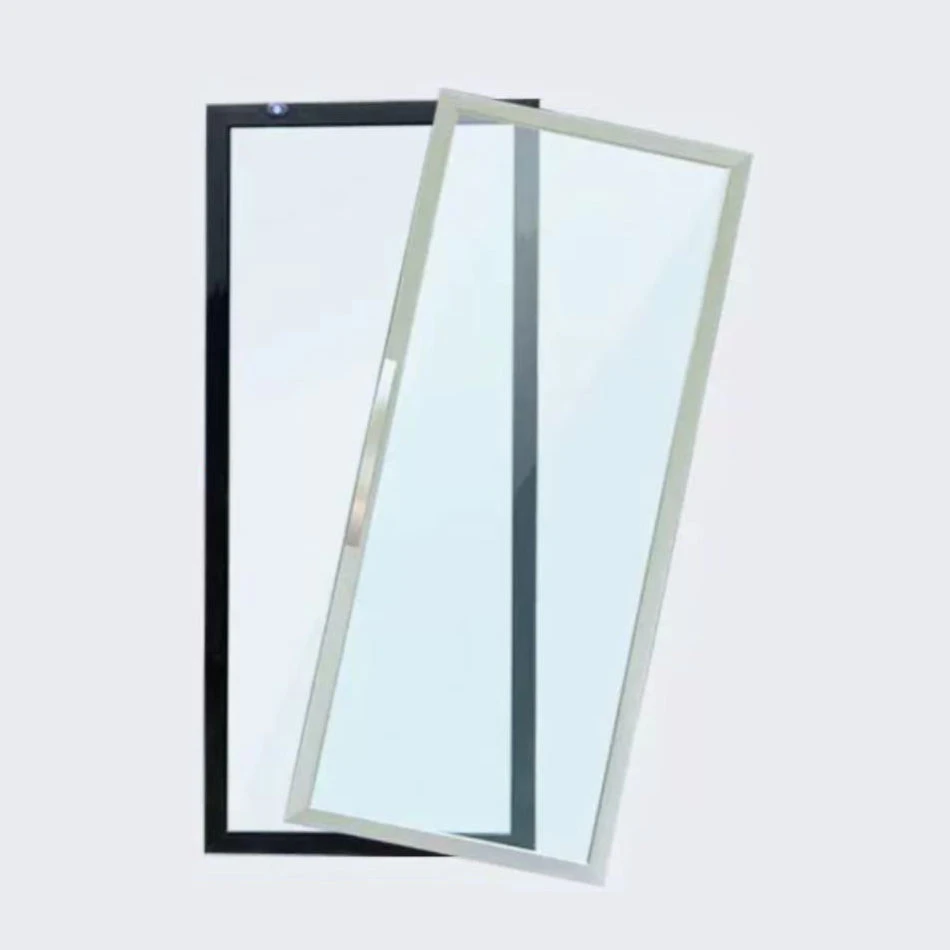
Typical ITO defog glass operates at 150-250 watts per square meter, depending on door size, ambient humidity, and target temperature. A standard upright freezer door might use 40-80 watts in total. That is far less than the energy lost when customers cannot see products and hold the door open longer.
Power is usually supplied at the voltage of the destination market: 110-120V for North America, 220-240V for Europe, Asia, and the Middle East. The bus bar layout and controller must match this voltage from the design stage; retrofitting later often requires a new transformer or controller.
Both technologies fight condensation, but their mechanisms, lifespans, and maintenance requirements are very different. The table below compares the two approaches side by side.
| Feature | ITO Heated Glass | Anti-Fog Coating |
|---|---|---|
| Working principle | Electrical heat through conductive film | Hydrophilic surface absorbs moisture |
| Power requirement | Requires wiring and controller | No electrical power |
| Defog speed | Rapid, even across whole pane | Slow, weak in high humidity |
| Lifespan | Long, film sealed inside IG unit | Coating degrades with cleaning cycles |
| Best use case | High-traffic freezer display doors | Low-budget or low-humidity cabinets |
| Custom shapes | Compatible with curved and double-pane IG | Usually limited to flat single-pane |
For a deeper technical comparison, read our ITO glass vs defogging coating guide.
Yes. ITO film can be deposited on curved tempered glass and then assembled into insulated glass units. This is common for pastry display cabinet glass and wine cooler cabinet glass, where the door needs both aesthetic curves and thermal performance. The film is typically placed on surface #2 or #3 of the IG unit to protect it from physical contact and cleaning chemicals.
Double-pane construction also improves energy efficiency. The outer pane carries the ITO film, the cavity is filled with argon, and the inner pane faces the cold cabinet. This combination cuts heat loss while keeping the exterior surface warm enough to stay clear.
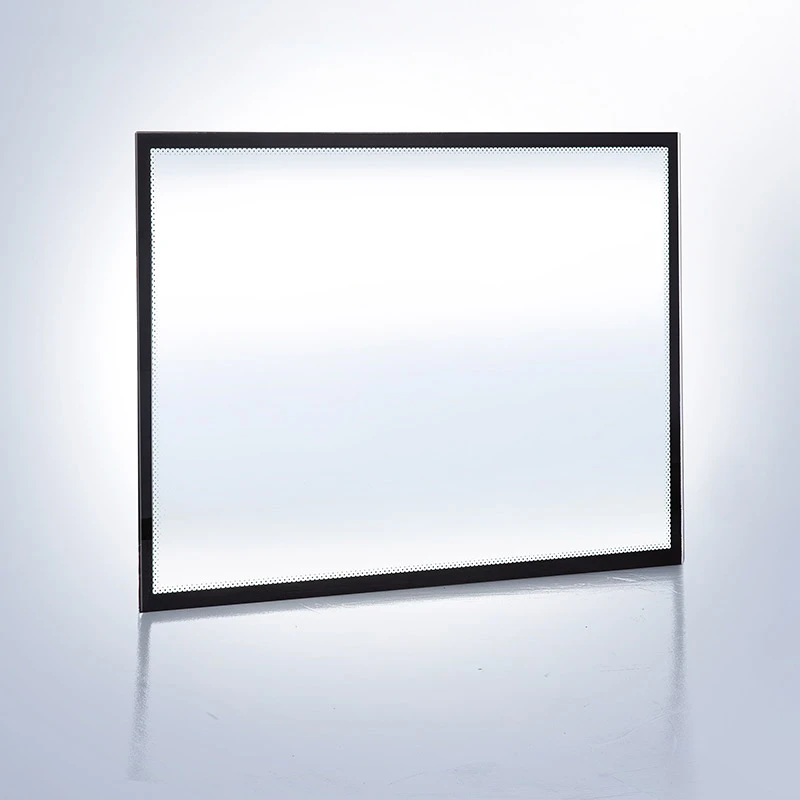
Not every glass factory that claims ITO capability actually controls the process. Ask for three things before approving a supplier: film resistance uniformity data, a 24-hour high-humidity defog test video, and a sample wired to your target voltage. If the supplier cannot provide resistance mapping, the film quality is likely inconsistent.
Also confirm where the ITO deposition, tempering, and IG assembly happen. Some traders source film-coated glass elsewhere and only assemble locally, which makes quality control harder. Huayin Glass performs cutting, edging, ITO coating, tempering, and IG assembly under one roof in our 6,000+ square meter Foshan plant.
Send a brief technical package: door dimensions, glass thickness, target voltage, cabinet temperature, and estimated annual volume. Huayin engineers will review feasibility, recommend a film power density, and quote a sample run. Standard flat door samples take 7-10 working days; curved or IG units take 10-15 working days.
Huayin Glass Solutions, established in 2002 in Foshan, Guangdong, supplies OEM glass components to 50+ countries. Our product range covers freezer glass doors, wine cooler glass, home appliance glass panels, curved tempered glass, and accessories. Learn more about our manufacturing capabilities or contact us for a sample and quotation.
Further reading: Product Catalog · Manufacturing · ITO vs Defogging Coating
Add:No. 16 Xingye Road, Beijiao Town Industrial Park, Shunde District, Foshan City, Guangdong Province
PHONE: +86 13509957538
TEL: +86 0757-26131933
Email: huayin_glass@163.com

© 2026 Huayin Glass Solutions All Rights Reserved.


