


 Add:No. 16 Xingye Road, Beijiao Town Industrial Park, Shunde District, Foshan City, Guangdong Province
 PHONE: +86 13509957538
 TEL: +86 0757-26131933
 Email: huayin_glass@163.com

Chinese


The thermal performance of a commercial freezer glass door depends not only on the glass itself but on the sealing and insulation technology that holds the insulated unit together and mounts it into the cabinet frame. A poorly sealed insulated glass unit (IGU) can lose 30-50% of its insulation value within five years due to gas leakage and moisture ingress. This technical guide examines the four critical components of freezer glass door sealing — butyl sealant, secondary sealant, warm-edge spacers, and thermal-break frame design — and explains how a China freezer glass door manufacturer like Huayin Glass ensures long-term energy efficiency through rigorous process control.
The sealing system of an insulated glass unit is the single most important factor in determining its service life. Commercial freezer doors use a dual-seal system consisting of a primary butyl seal and a secondary structural seal.
Polyisobutylene (PIB) butyl sealant is applied as a continuous bead along the spacer bar edge. Butyl has extremely low moisture vapor transmission rate (MVTR) — typically less than 0.1 g/m²/day — making it the primary barrier against moisture ingress. In freezer applications, the butyl seal prevents humid ambient air from penetrating the gap between the two glass lites. If moisture enters, it condenses as frost on the interior surfaces, destroying the insulating gas fill and visibly fogging the unit.
The secondary seal provides structural strength, holding the two glass lites together against wind load, temperature differential, and mechanical handling. Two materials dominate: polysulfide (for standard commercial freezers) and structural silicone (for high-performance and heated glass doors where the unit also carries ITO heating elements). Structural silicone offers superior UV resistance and higher tensile strength, making it the preferred choice for commercial freezer glass doors exported to high-temperature regions like the Middle East and Southeast Asia.
For heated glass door applications where ITO conductive film is used, the sealing system must also accommodate electrical lead-through points. Huayin Glass engineers the seal geometry so that the power terminals pass through the secondary seal without compromising the butyl primary moisture barrier. See our ITO glass vs defogging coating comparison for more on heated glass edge termination.
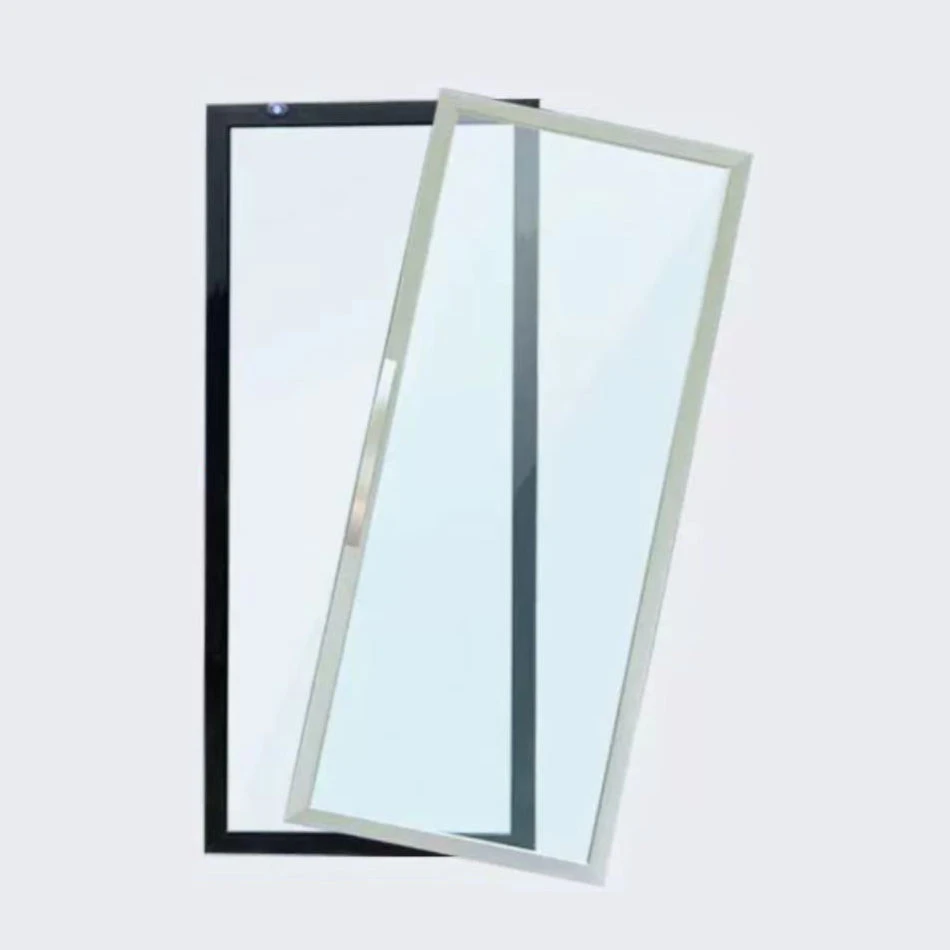
The spacer bar sits between the two glass lites, maintaining the gap width and holding the desiccant that absorbs residual moisture inside the IGU. Traditional aluminum spacers are excellent conductors — they create a thermal bridge at the glass edge that can increase edge heat loss by 40% compared to the center of the glass.
Modern warm-edge spacers use stainless steel (conductivity ~15 W/mK, vs. aluminum at ~200 W/mK) or thermoplastic composite spacers (TPS) that further reduce edge heat transfer. The thermal performance improvement is measurable: switching from an aluminum spacer to a warm-edge spacer can improve the overall U-value of the IGU by 0.1-0.2 W/m²K, which translates to 5-8% less compressor runtime for the freezer cabinet.
The spacer cavity contains molecular sieve desiccant beads that absorb moisture trapped inside the IGU during manufacturing. A typical 12mm spacer holds 0.5-0.8g of desiccant per linear meter. For freezer applications, Huayin Glass specifies an oversized desiccant charge — 1.0-1.2g per linear meter — to accommodate the higher moisture load associated with low-temperature operation. This extends the IGU service life from the industry-standard 10 years to 15+ years in commercial freezer conditions.
Curved glass doors require custom-bent spacers. Huayin's curved tempered glass line includes specialized spacer bending equipment that maintains consistent desiccant fill along the entire arc.
Filling the gap between the two glass lites with argon gas reduces convective heat transfer by approximately 30% compared to air. Argon is non-toxic, non-reactive, and relatively inexpensive. The initial fill concentration should be 90-95% or higher.
Huayin Glass uses an automated gas-fill station that evacuates the IGU cavity and backfills with argon in a single pressurized cycle. The result is a consistent 93-95% argon concentration, verified by a spark emission gas analyzer on every production batch. Manual fill methods — common in small workshops — typically achieve only 85-88% concentration, leaving more residual air that carries moisture and reduces insulation.
Even with perfect initial fill, argon slowly permeates through the sealant over years. The industry benchmark (EN 1279-3) requires that the IGU retain at least 80% of its initial gas fill after 10 years. A well-built dual-seal unit with warm-edge spacers typically loses 0.5-1.0% argon per year, meaning a 95% initial fill still exceeds 85% after 10 years. This is why Huayin's manufacturing process invests heavily in sealant application precision and automated gas-fill equipment — the upfront cost pays back through decades of energy savings.
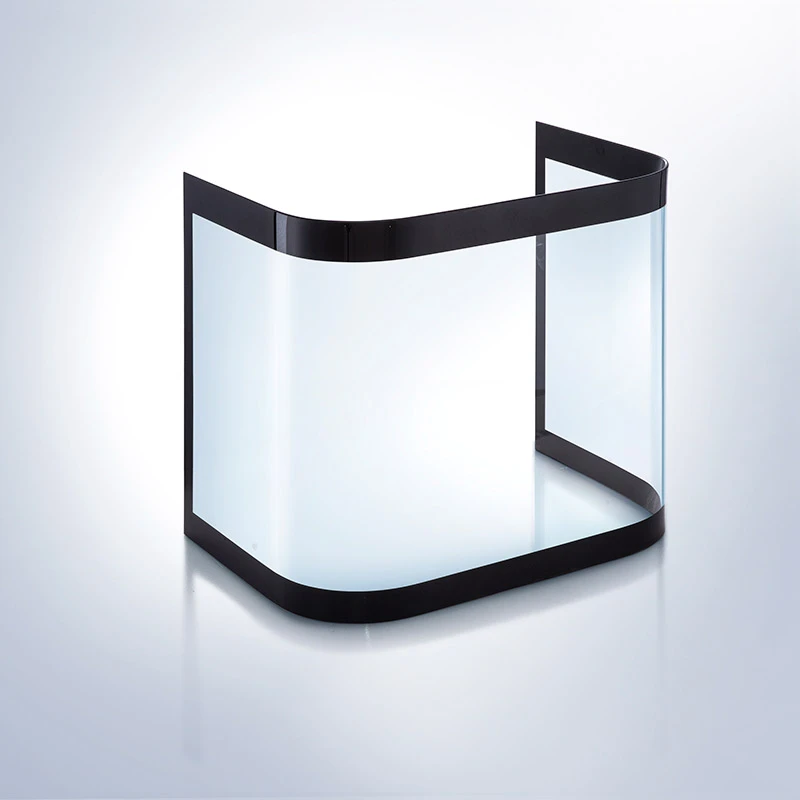
The aluminum frame that holds the glass door in the cabinet is another critical thermal path. Standard aluminum profiles conduct heat so efficiently that frost can form on the exterior frame even when the glass center remains clear. A thermal break — a polyamide strut inserted between the interior and exterior aluminum profiles — interrupts this conduction path.
Huayin Glass uses 14-24mm polyamide (PA66) struts with glass fiber reinforcement, achieving frame U-values 40-60% lower than non-thermal-break profiles. The strut width is selected based on the cabinet's operating temperature: standard chillers (2-8°C) use 14mm; low-temperature freezers (-18 to -25°C) use 24mm struts for maximum insulation.
The interface between the glass and the frame requires a flexible gasket that accommodates thermal expansion while maintaining an air-tight seal. Huayin supplies magnetic door gaskets and PVC extruded gaskets in profiles matched to common cabinet brands. For custom OEM doors, the gasket groove geometry is machined into the frame per the customer's specification.
The following table compares the three most common IGU sealing approaches found in commercial freezer doors:
| Dimension | Single- Seal (Polysulfide) | Dual-Seal (Butyl+Silicone) |
|---|---|---|
| Moisture barrier | Polysulfide only | PIB butyl primary + silicone secondary |
| MVTR (g/m²/day) | ~2.0 | <0.1 |
| Service life (freezer) | 5-8 years | 12-15+ years |
| Argon retention (10yr) | ~70% retained | ~85%+ retained |
| Typical application | Entry-level chillers | Commercial freezers, heated doors |
The dual-seal system is standard on all Huayin Glass commercial freezer glass and heated glass door products. The additional material cost (approximately 8-12% over single-seal) is recovered within 2-3 years through reduced compressor energy consumption.
Q: How can I verify that my supplier uses dual-seal technology?
A: Request a cross-section photo of the IGU edge. A dual-seal unit will show a thin dark line of butyl adjacent to the spacer, surrounded by a thicker layer of silicone or polysulfide. A single-seal unit shows only one sealant layer. Also request the EN 1279-3 gas retention test report.
Q: Does warm-edge spacer technology cost significantly more?
A: Stainless steel warm-edge spacers add approximately 5-7% to the IGU cost. The energy savings typically recover this within 18 months of continuous freezer operation, making it a standard specification for any door that will be in service for more than 3 years.
Q: Can curved glass doors use the same sealing technology?
A: Yes. Huayin Glass manufactures hot-bent insulated heating glass with the same dual-seal and warm-edge system. The curved spacer bars are precision-bent on specialized equipment to match the glass arc, ensuring consistent sealant geometry along the entire perimeter.
Q: What desiccant is used and how is it inspected?
A: Molecular sieve 3A is standard. Huayin inspects desiccant saturation before every production run by weighing the desiccant charge and verifying moisture pickup is below 2% by weight. Oversized charges are used for freezer applications to extend service life.
Freezer glass door sealing and insulation technology is invisible to the end consumer, but it determines whether a commercial freezer performs efficiently for 15 years or fails in 5. The combination of PIB butyl primary seal, structural silicone secondary seal, warm-edge stainless steel spacers, oversized desiccant charge, automated argon gas fill, and thermal-break aluminum frames represents the current best practice in commercial refrigeration glass. As a China freezer glass manufacturer with 25 years of experience, Huayin Glass Solutions implements all of these technologies as standard on every commercial freezer door, including custom track-mounted sliding glass doors and custom-logo glass doors.
For OEM pricing or technical consultation, please contact Huayin Glass. Explore our client case studies and featured projects for real-world applications.
Further reading: Refrigerator Glass Door Series · Wine Cooler Cabinet Glass · Pastry Display Cabinet Glass
Add:No. 16 Xingye Road, Beijiao Town Industrial Park, Shunde District, Foshan City, Guangdong Province
PHONE: +86 13509957538
TEL: +86 0757-26131933
Email: huayin_glass@163.com

© 2026 Huayin Glass Solutions All Rights Reserved.


