


 Add:No. 16 Xingye Road, Beijiao Town Industrial Park, Shunde District, Foshan City, Guangdong Province
 PHONE: +86 13509957538
 TEL: +86 0757-26131933
 Email: huayin_glass@163.com

Chinese


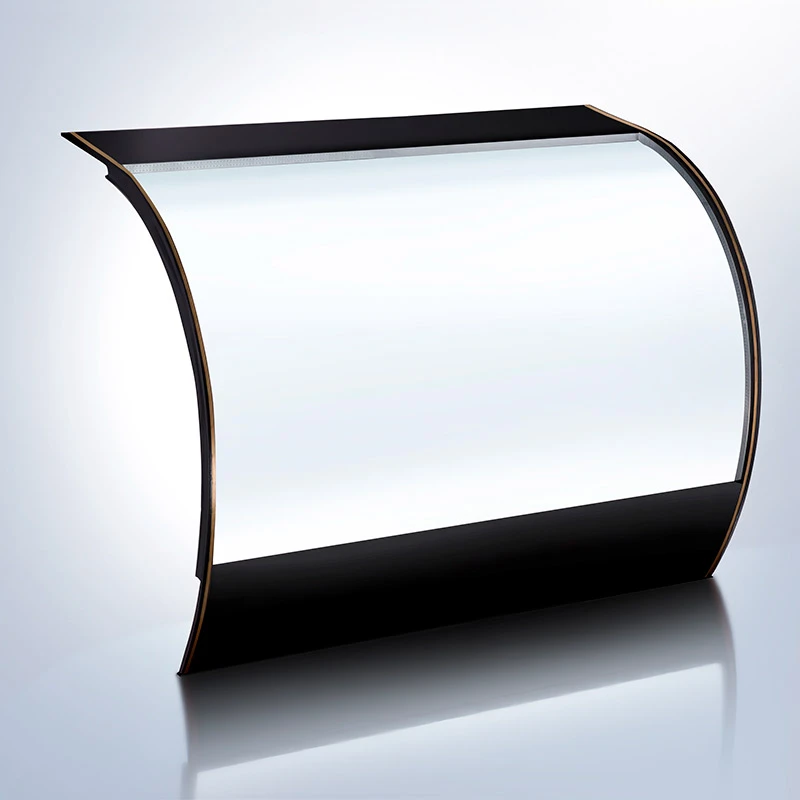
A curved defogging glass panel is a transparent conductive coating on a bent, tempered lite, energised through two busbars so that the surface stays above the dew point. The coating is the same family used on flat doors — indium tin oxide, or ITO — but curvature changes three things that decide whether the panel clears evenly: the uniformity of the coating after bending, the current path between the busbars, and the heat loss at the frame. Treating a curved panel as a flat panel with a radius is the most common reason a display case fogs in a band while the rest of the glass stays clear.
On a flat panel, current flows in straight lines between parallel busbars, and the resistance of any strip is proportional to its length. Bend that panel and the outer surface stretches while the inner surface compresses; the coating, deposited before bending, stretches with the glass. Sheet resistance rises slightly on the convex face and the current redistributes toward the shorter path along the chord.
The practical result is a temperature profile that is not uniform. The centre of the arc, where the current path is shortest, runs hotter; the two ends, where the path is longer and the frame sinks heat, run cooler. If the cold end falls below the dew point, a vertical band of fog appears within minutes of door opening, no matter how much total power the panel draws.
Curvature also changes the frame contact. A curved door closes against a curved gasket line, and the gasket compresses unevenly along the arc. The resulting air leakage concentrates at the ends of the arc — exactly where the panel is coolest.

ITO is deposited on flat glass and then bent, because sputtering onto a curved surface cannot hold a uniform sheet resistance across the arc. The consequence is that bending becomes a coating process step: the film must survive 600°C-plus without losing conductivity, and it must stretch without cracking.
Set the budget before sampling. A workable specification for display doors is a nominal sheet resistance with a tolerance of ±10% measured at five points across the lite, plus a visual limit on haze and a cross-hatch adhesion test after bending. Tighter than ±10% is achievable on gentle radii and expensive on tight ones; looser than ±15% will produce visible hot bands under thermal imaging.
Film thickness and glass thickness interact here. Thicker glass needs a longer furnace cycle and more heat to reach bending temperature, which increases the thermal load on the film. That is why a 6 mm curved panel is not simply a scaled version of a 4 mm one.
The busbar is a fired silver-frit strip that collects current from the film and delivers it to a terminal. On a curved panel, the busbar has to follow the arc rather than cut across it. A straight chord busbar on a curved lite creates a current path whose length varies across the width, and the result is a hot band along the centreline.
Two layouts work. The first runs both busbars along the two long edges, following the arc; current flows across the short dimension and the path length is nearly constant. The second places busbars on the two short ends for panels that are wide and shallow, accepting a longer path but gaining a shorter wire run to the cabinet harness.
Terminal position matters as much as busbar geometry. Put the terminal at the coolest end of the panel, not the centre, so the connection does not sit in the hottest zone; encapsulate it with a flexible potting compound rather than a rigid epoxy, because the bent lite moves slightly under thermal cycling and a rigid joint cracks.
Minimum radius is governed by tensile strain on the outer surface and by what the mould can hold during quenching. The values below are working starting points for soda-lime glass; every new radius should be proven on a sample before the drawing is frozen.
| Glass thickness | Minimum inside radius | Engineering note |
|---|---|---|
| 4 mm | 400 mm | Most display cabinet fronts; coating stretch is manageable |
| 5 mm | 500 mm | Common for heated pastry and wine cabinet doors |
| 6 mm | 600 mm | Heavier doors; allow extra time in the bending furnace |
| 8 mm | 800 mm | Large commercial cases; consider laminated build instead |
| Insulated unit | Add 100–150 mm to the single-lite value | Spacer bending and secondary seal need clearance |
Below these radii the failure mode is not always immediate. A panel can come out of the furnace intact and delaminate at the coating after two hundred thermal cycles, which is why radius limits should be validated by cycling, not by visual inspection on day one.
Most curved defogging panels ship as an insulated unit, with the heated lite as the ambient-facing pane. That arrangement puts the heat where the condensation forms and keeps the cold-side pane at cabinet temperature. Coating position follows the usual rule: Low-E on the cavity face, ITO on the outer face of the heated lite.
The spacer is the weak point. A rigid aluminium spacer does not bend to the arc, so curved IGUs use a bendable spacer or a warm-edge profile that can follow the radius. The secondary seal must stay continuous around the bend; a gap of two millimetres at the tightest point is enough to let moisture into the cavity, and the unit fails as an IGU long before the heater fails.
Argon filling on a curved unit needs a longer settling time than on a flat one, because the cavity is not uniform in width. Ask for the fill record and, if the project justifies it, a retained-concentration check on a sample after 24 hours. Our hot bent insulated heating glass programme runs bending, coating and insulated assembly in one plant, which keeps the radius of the glass and the radius of the spacer in the same tolerance chain.
Fog is a lagging indicator. Test the panel before it reaches a shop floor by measuring surface temperature under controlled conditions and comparing the coldest point with the dew point of the test air.
| Test | Method | Acceptance |
|---|---|---|
| Thermal uniformity | Thermal camera after 10 min at rated voltage | Max minus min ≤4°C across the visible area |
| Fog clearance | 25°C / 80% RH chamber, door opened 20 times/hour | Clear within 5 min, no residual band at the ends |
| Power density | Measured watts divided by visible area | Within ±10% of the specified W/m² |
| Insulation | 500 V DC insulation tester, terminal to frame | ≥20 MΩ, no drift after thermal cycling |
| Busbar adhesion | Cross-hatch, 3M tape pull | No film lift at the bend apex |
Keep the thermal image with the batch record. When a customer reports fogging six months later, the image is the only evidence that separates a panel fault from a gasket leak or a failed controller.
| Term | Meaning |
|---|---|
| Sheet resistance | Film resistance per square, in ohms per square; sets current spread across the panel |
| Busbar | Silver-frit conductor that collects current from the film and feeds the terminal |
| Power density | Electrical power per unit of visible area, usually W/m² |
| Hot band | A narrow overheated strip caused by a shorter current path or uneven film |
| Dew point | Temperature at which air at a given humidity begins to condense |
RFQ checklist: panel drawing with radius; glass thickness and build; target power density and supply voltage; busbar layout and terminal position; IGU or single pane; spacer type for the arc; thermal image and insulation record per batch; and a cycling test report for any radius below the table values.
Send a drawing with the radius marked and a photo of the cabinet opening to our engineers through the contact page for a feasibility check on a curved tempered anti-fog glass panel. Huayin Glass Solutions has coated, bent and tempered glass in Foshan since 2002, with ISO 9001:2015 and China CCC certification, exporting to more than 50 countries.
Further reading: Curved tempered coated heated IG glass · Thermally bent glass · Curved tempered glass · Manufacturing
Huayin Glass Solutions was established in 2002 in Beijiao Town, Shunde District, Foshan, Guangdong, China, next to the Beijiao, Nansha and Huangpu ports. With 6,000+ square meters of manufacturing space, the company specialises in high-end glass deep processing and custom OEM/ODM services. Core technologies include ITO transparent conductive film heating, multi-curvature hot bending and tempering, Low-E energy-saving coating, and argon-filled insulated glass. The product range covers commercial freezer glass doors, wine cooler glass, pastry display cabinet glass, supermarket freezer glass, home appliance glass panels, curved tempered glass and accessories. Certified to ISO 9001:2015 and China CCC, exporting to 50+ countries.
Huayin Glass Solutions · Custom glass deep processing and OEM/ODM · English site · Chinese site · About us · Contact
Add:No. 16 Xingye Road, Beijiao Town Industrial Park, Shunde District, Foshan City, Guangdong Province
PHONE: +86 13509957538
TEL: +86 0757-26131933
Email: huayin_glass@163.com

© 2026 Huayin Glass Solutions All Rights Reserved.


