


 Add:No. 16 Xingye Road, Beijiao Town Industrial Park, Shunde District, Foshan City, Guangdong Province
 PHONE: +86 13509957538
 TEL: +86 0757-26131933
 Email: huayin_glass@163.com

Chinese


Safety glazing on a refrigeration door is defined by numbers, not by adjectives. A tempered lite is "safety glass" only when its surface compression, fragmentation pattern, edge quality and marking satisfy a named standard, and the three standards that dominate export orders — EN 12150 in Europe, ANSI Z97.1 in North America and GB 15763.2 in China — set different thresholds for the same sheet. A door that passes one is not automatically compliant with the other two. This whitepaper sets out where the thresholds differ, which tests expose the difference, and what a buyer should witness before a container leaves the factory.
Tempered glass is float glass heated to roughly 620–640°C and then quenched with air, which locks the surfaces in compression and the core in tension. The resulting surface compression is what raises bending strength to about four times that of annealed glass and what makes the sheet break into small, relatively blunt fragments instead of long shards.
Three properties follow from that process, and each is separately specified: the fragmentation pattern, the surface compression value, and the resistance to spontaneous breakage caused by nickel sulphide inclusions. A supplier who reports only "tempered to standard" has reported none of them.
For a refrigerator glass door, the practical question is not whether the lite is tempered but whether the tempering survived the rest of the process. Holes, cut-outs, screen printing, coating and bending all interrupt the stress field, and every one of them is a place where a compliant sheet becomes a non-compliant door.
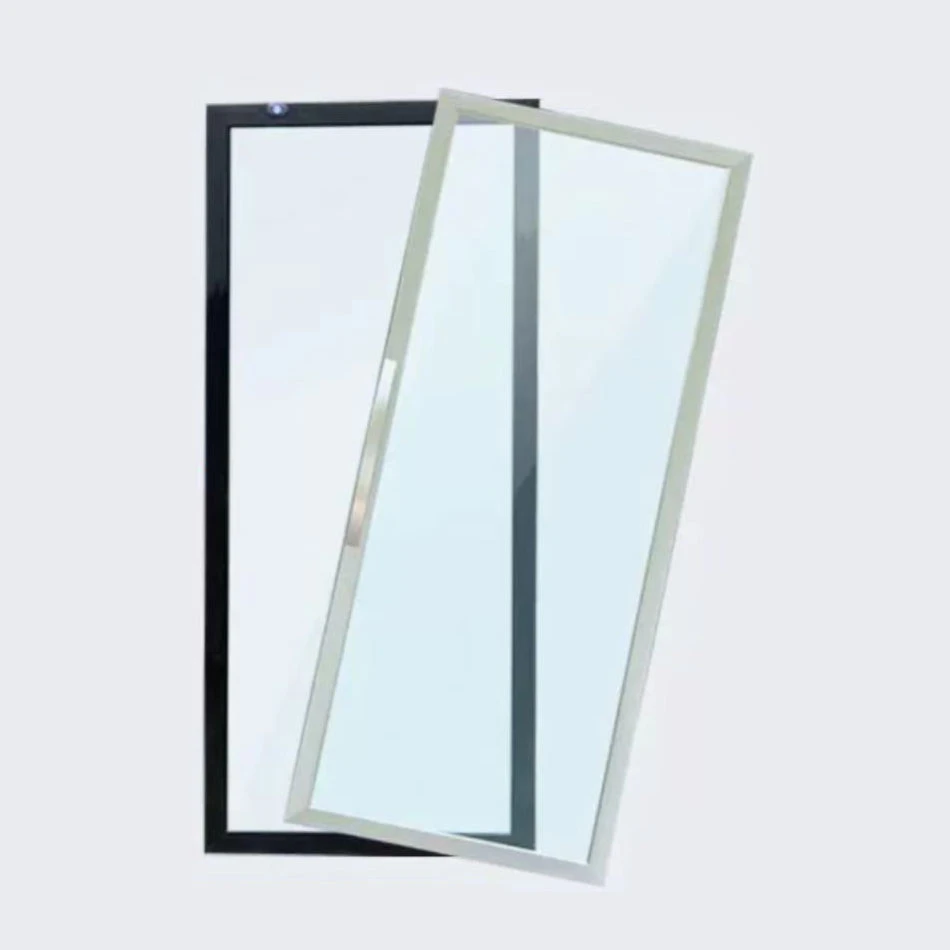
Most export contracts name a standard in one line and leave the test methods to the supplier. The table below shows what each standard actually controls, which is the first thing to fix in a purchase specification.
| Standard | Market | What it fixes |
|---|---|---|
| EN 12150-1 | Europe (CE marking under CPR) | Fragmentation, surface compression ≥69 MPa, bow and flatness, dimensional tolerances |
| ANSI Z97.1 / ASTM C1048 | North America | Impact performance by drop height and category, plus heat-treated glass requirements |
| GB 15763.2 | China (CCC marking) | Fragmentation, surface compression ≥90 MPa, heat soak option, appearance limits |
The compliance route matters as much as the number. In Europe the lite carries CE marking through the door manufacturer's declaration of performance; in China the glass itself carries a CCC mark and a certificate number that can be checked online; in North America the glazing is qualified by impact test, usually at a laboratory, and the certificate applies to a specific construction.
The fragmentation test breaks a 300 × 300 mm sample and counts the particles inside a 50 × 50 mm window placed away from the impact point and away from the edges. Both EN 12150 and GB 15763.2 require at least 40 particles in that window for glass from 4 mm to 12 mm thick. Long, needle-shaped fragments near the edge are the classic sign of under-tempering, and they are also the fragments most likely to cut.
| Thickness | Minimum particles per 50 × 50 mm | Buyer note |
|---|---|---|
| 4 mm | 40 | Most common for insulated display doors; check bow as well |
| 5–6 mm | 40 | Standard for hinged freezer doors with hardware holes |
| 8–10 mm | 40 | Heavy doors and curved lites; particle size grows with thickness |
Ask for the test report rather than a photograph of a broken sample. The report should name the furnace batch, the date, the thickness and the particle count; a fragmented picture without a batch number proves nothing about the lites in your container.
Surface compression is measured optically with a surface stress meter and expressed in megapascals. EN 12150 sets the minimum at 69 MPa; GB 15763.2 sets it at 90 MPa. The difference is not cosmetic — a lite at 72 MPa is fully compliant in Europe and non-compliant in China, and a lite at 95 MPa has a fragmentation pattern that is finer and, in practice, more resistant to thermal shock.
Higher compression also raises the risk that comes with tempering: the stored energy is larger, so any inclusion or edge damage releases more energy when it fails. That is why heat soak testing matters more, not less, as compression goes up.
Spontaneous breakage in tempered glass usually traces to a nickel sulphide inclusion that changes volume over time, cracking the lite from the core outward. Heat soak testing accelerates that transformation: EN 14179 specifies holding the glass at 290°C ±10°C for two hours, then cooling it slowly, so that lites with critical inclusions break in the oven instead of in a supermarket.
Heat soak does not eliminate the risk, it screens it. For doors installed in high-temperature, high-humidity locations — or for any project where a broken door means a lost day of trading — specify heat soak and require the batch records. On freezer glass programmes we run soak testing on the same furnace batch used for the order, so the records map one-to-one to shipped lites.
Tempering strength lives in the edge. A polished edge with chips under 1 mm and no visible shelling will outperform a ground edge with a single 2 mm nick, because every notch concentrates stress. Specify edge quality in the drawing, not in conversation.
Holes and cut-outs have geometric rules that cannot be negotiated after tempering: hole diameter should be at least the glass thickness, the distance from hole edge to glass edge at least twice the thickness, and the distance between two holes at least twice the thickness. Violating these does not always break the lite in the furnace — it breaks it three months later at the hinge.
Curved doors add a second constraint. On a curved tempered glass lite, the hardware zone sits in a region where the stress field is already asymmetric, so hole position tolerance and edge distance should be agreed against the bending mould, not against the flat drawing.

Every lite should carry a permanent mark: standard reference, thickness, tempering date or batch code, and the manufacturer's identifier. The mark is what lets a buyer trace a failed door back to a furnace run two years after delivery.
The acceptance sheet below is the minimum a buyer should witness or receive before shipment. It converts each clause of the standard into a record.
| Check | Method | Acceptance |
|---|---|---|
| Fragmentation | Break sample, count 50 × 50 mm window | ≥40 particles, no long edge shards |
| Surface compression | Surface stress meter, 5 points per lite | ≥69 MPa (EN) or ≥90 MPa (GB) |
| Heat soak | Batch record, 290°C / 2 h | Record matches order batch, zero failures shipped |
| Edge and holes | Visual plus caliper, 100% of lites | Chip ≤1 mm, hole and edge distances per drawing |
| Marking | Visual, permanent etch or print | Standard, thickness, batch, maker ID legible |
A door programme that keeps these five records per batch will resolve almost any quality dispute without a third-party laboratory, which is the real value of certification: not the certificate, but the traceability behind it. Our glass manufacturing lines run tempering, bending, coating and insulated assembly under one roof, so the batch number on the lite and the batch number on the IGU record are the same number.
| Term | Meaning |
|---|---|
| Surface compression | Compressive stress locked into the glass surface by quenching, measured in MPa |
| Fragmentation test | Controlled breakage of a sample to count particles in a 50 × 50 mm window |
| Heat soak test | Hold at 290°C for two hours to force nickel sulphide inclusions to fail before delivery |
| Bow and warp | Deviation from flatness after tempering, measured over the diagonal |
| Edge shelling | Flaking of the edge arris that reduces local strength and must be limited |
Pre-order checklist: name the standard and edition; state the surface compression threshold; require fragmentation reports per batch; specify heat soak where trading continuity matters; draw hole and edge distances; require permanent marking; and agree the acceptance sheet before the first lite is cut.
For a specification review on a specific door, send drawings, target market and annual volume to our engineers through the contact page. Huayin Glass Solutions has produced custom tempered and curved lites in Foshan since 2002, certified to ISO 9001:2015 and China CCC, and exports to more than 50 countries.
Further reading: Refrigerator glass door · Freezer glass · Curved tempered glass · Products
Huayin Glass Solutions was established in 2002 in Beijiao Town, Shunde District, Foshan, Guangdong, China, next to the Beijiao, Nansha and Huangpu ports. With 6,000+ square meters of manufacturing space, the company specialises in high-end glass deep processing and custom OEM/ODM services. Core technologies include ITO transparent conductive film heating, multi-curvature hot bending and tempering, Low-E energy-saving coating, and argon-filled insulated glass. The product range covers commercial freezer glass doors, wine cooler glass, pastry display cabinet glass, supermarket freezer glass, home appliance glass panels, curved tempered glass and accessories. Certified to ISO 9001:2015 and China CCC, exporting to 50+ countries.
Huayin Glass Solutions · Custom glass deep processing and OEM/ODM · English site · Chinese site · About us · Contact
Add:No. 16 Xingye Road, Beijiao Town Industrial Park, Shunde District, Foshan City, Guangdong Province
PHONE: +86 13509957538
TEL: +86 0757-26131933
Email: huayin_glass@163.com

© 2026 Huayin Glass Solutions All Rights Reserved.


