


 Add:No. 16 Xingye Road, Beijiao Town Industrial Park, Shunde District, Foshan City, Guangdong Province
 PHONE: +86 13509957538
 TEL: +86 0757-26131933
 Email: huayin_glass@163.com

Chinese


A freezer glass door hinge carries 15 to 45 kilograms through tens of thousands of cycles below -18 °C while holding a magnetic gasket at sealing compression. Most field complaints that reach a glass supplier — a door hanging low at the handle, a gap opening at the top corner, cracks radiating from a screw hole — begin in hinge selection and hole geometry, not in the glass. This brief converts door weight into hinge count and torque, and lists the checks that predict whether a door still seals after two years.
Four loads act on a door hinge, and they are rarely specified separately. The first is shear: the dead weight of glass, frame, handle, LED strip and, on heated doors, the terminal block, all transferred through the hinge cup into the cabinet post. The second is torque from the spring, which must be large enough to close the door against the gasket and small enough that a shopper can open it one-handed. The third is peel load from gasket compression: a magnetic gasket held at 30 to 50 percent compression pushes the door away from the frame along its whole perimeter, and the hinge nearest the handle resists most of it. The fourth is dynamic load from slamming, which multiplies the static loads by a factor that rises sharply once spring torque is overspecified.
Because these loads pull against each other, a hinge cannot simply be upgraded for strength: a stronger spring raises the slam impulse, which raises the peel load at the far corner, which demands more gasket compression. The set has to be matched as a whole.
Hinge count follows weight, and weight follows glass configuration. The figures below are per square metre of glazing; add 3 to 6 kilograms for an aluminium door frame, handle and light module on a typical merchandising door.
| Glass build-up | Approximate weight | Where it is used |
|---|---|---|
| Single pane, 6 mm tempered | 15 kg per m² | Ambient display cabinets, dry pastry cases |
| 5 + 12A + 5 insulated unit | 25 kg per m² | Chilled coolers, wine cabinets, bakery cases at 2–8 °C |
| 5 + 9A + 5 + 9A + 5 triple | 35 kg per m² | Freezers below -15 °C, high-humidity retail, large door faces |
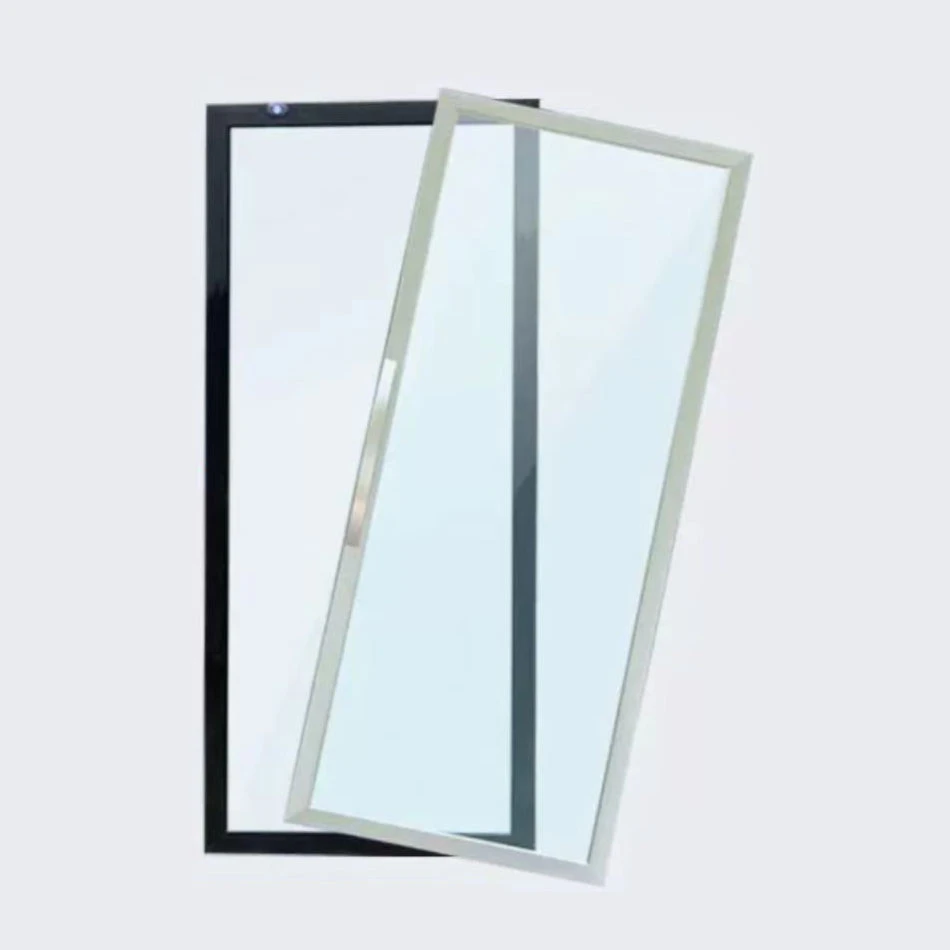
A 1170 × 600 mm door is 0.70 m²: about 22 kilograms assembled on a double-glazed build, close to 30 kilograms on a triple. That gap of eight kilograms alone moves the door from a two-hinge specification to a three-hinge one — the most common omission in first enquiries, where the glass is quoted but the door is never weighed.
Add a margin of 1.3 to 1.5 times the calculated weight. The margin covers handling during delivery and installation, and the fact that a door in service opens far more often than the design brief assumed; the self-closing hinge and spring hinge range is specified against it rather than against nominal weight.
Torque is quoted in newton-metres and is the only number that connects a hinge to a door it can actually close. The bands below reflect conventional practice on merchandising doors; they assume two hinges minimum and a gasket at 30 to 50 percent compression.
| Assembled door weight | Hinges per door | Torque per hinge |
|---|---|---|
| Up to 25 kg | 2 | 1.5–2.0 N·m |
| 26–45 kg | 3 | 2.0–3.0 N·m |
| 46–70 kg | 3–4 | 3.0–4.5 N·m |
| Above 70 kg | 4 or more | 4.5 N·m and up |
The self-closing window is set by ramp angle as much as by torque. A door should begin to close on its own from 15 to 20 degrees open and pull itself shut from about 5 degrees. That gives a field test: open the door 5 degrees, release it, and count. Closing within two seconds is in range; a snap with an audible impact means the spring is over-specified and the gasket will take the punishment; staying ajar means a frost line along the opening edge within a season.
Over-torque is the more common error in export orders, because a buyer who has received complaints about doors left open tends to specify a stronger spring. The correct response is a third hinge or wider hinge spacing, not a heavier spring.
Hinge holes are the weakest feature in a tempered door, because tempering locks the stress state around every hole and edge at the moment of quenching. Two rules govern the layout: hole centres at least 250 mm apart on a door of normal height, and at least 2.5 times the glass thickness from any edge. On a 5 mm pane that is 12.5 mm measured to the hole perimeter, not to the centre, and on a stepped-edge door the measurement starts from the thinnest section.
Diameter tolerance matters as much as position. Holes are drilled at ±0.3 mm and the hinge is located by a steel bushing, not by screw thread alone; a hole that is 0.5 mm oversize lets the door shift laterally under load, and that movement is what cracks the glass after a few thousand cycles. Internal corners need a radius of at least 2 mm, screw torque should be applied with a clutch driver, and a hole placed inside a curve transition is a fatigue crack waiting to happen — one that can only be corrected on the drawing, never after tempering.
Three things change below -18 °C. The gasket compound hardens, so the force needed to break the magnetic seal rises by 20 to 40 percent: a door that opens with 30 newtons in a showroom can demand 42 newtons in a frozen aisle. The spring itself loses little torque, but grease viscosity rises. And the hinge side of the glass runs coldest, because the bracket is a thermal bridge through the frame — which is where the first frost line appears.
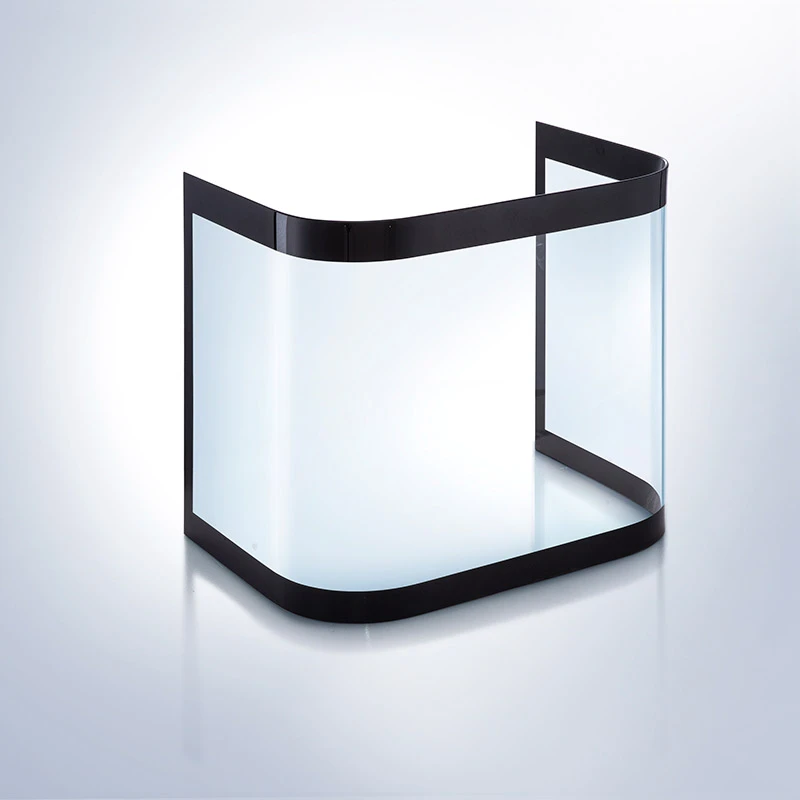
Heated doors add a fourth variable. An ITO-coated or laminated door with terminal block and wiring weighs 0.5 to 1.5 kilograms more, and the harness must be routed clear of the hinge cup and its swing arc; a wire pinched in a cup is a short circuit measured in weeks. On curved doors the hinge plane has to follow the tangent at the mounting point, which is why curved tempered coated heated IG glass is drilled before bending, never after.
| Symptom | Root cause | Correction |
|---|---|---|
| Handle side hangs low after 6–12 months | Torque under-rated for the measured door weight | Add a third hinge or move to the next torque band |
| Door shifts sideways when pushed | Hole 0.5 mm oversize, or bushing worn | Hold ±0.3 mm on hole diameter; specify steel bushing |
| Cracks radiating from a screw hole | Edge distance below 2.5t, or screw over-torqued | Redraw hole position; use a clutch driver |
| Gap opens at the top and bottom corners | Hinge axis not parallel to the cabinet post | Shim the post, then re-check the door diagonal |
| Frost line along the hinge side only | Bracket thermal bridge plus gasket compressed over 50 percent | Warm-edge frame detail; reset gasket compression |
Read together, the table separates glass faults from hardware faults. A crack that starts at the hole is a hardware and drawing problem; a crack that starts at a free edge with no hole nearby is a handling or edge-work problem, and belongs to a different conversation with the manufacturing team.
Items one and three eliminate most warranty arguments before they start. A supplier who asks for the door weight and the gasket section before quoting hinges is working to a specification; one who quotes by door height alone is working from a catalogue.
| Term | Definition |
|---|---|
| Hinge torque | Rotational force produced by the spring, expressed in newton-metres, that closes the door against the gasket |
| Sag | Downward movement of the free edge of a door caused by insufficient torque or hinge count for the door weight |
| Hinge cup | Recessed housing that seats the hinge body in the glass or frame and transfers load into the door |
| Compression set | Permanent deformation of a gasket after prolonged compression; the main cause of seal loss over time |
| Edge distance | Distance from the perimeter of a hole or cut-out to the nearest glass edge, normally at least 2.5 times the thickness |
Q: Can hinges be supplied with the glass door as one assembly?
A: Yes, and it is the more reliable route. When hinges, gasket and glass are drilled and matched by one supplier, the hole pattern, gasket section and torque band are validated together at sample stage. Split sourcing across three vendors is where tolerance chains usually break, which is why the refrigerator glass door and freezer glass programs ship as assemblies with hardware from the accessories series.
Q: How often should hinge torque be re-checked in service?
A: Once at commissioning and once at the end of the first cooling season. Spring torque is stable, but gasket compression set is not: a gasket that has taken a permanent set will let the door sit further from the frame, and the hinge will be blamed for a seal failure it did not cause. The magnetic door gasket section of the catalogue sets out the compression figures to check against.
Huayin Glass Solutions has produced custom glass doors and matched hardware since 2002 from a 6,000+ square metre facility in Beijiao, Shunde, Foshan, certified to ISO 9001:2015 and China CCC, with exports to more than 50 countries. Hinge and gasket matching is handled at drawing stage for commercial supermarket freezer glass and wine cooler cabinet glass alike.
Send your door schedule with glass build-up and gasket section for a hinge-to-load review: contact our engineering team.
Further reading: Products · Featured projects · About us
Add:No. 16 Xingye Road, Beijiao Town Industrial Park, Shunde District, Foshan City, Guangdong Province
PHONE: +86 13509957538
TEL: +86 0757-26131933
Email: huayin_glass@163.com

© 2026 Huayin Glass Solutions All Rights Reserved.


