


 Add:No. 16 Xingye Road, Beijiao Town Industrial Park, Shunde District, Foshan City, Guangdong Province
 PHONE: +86 13509957538
 TEL: +86 0757-26131933
 Email: huayin_glass@163.com

Chinese


A two-hour factory tour tells you almost nothing. Showrooms are clean, machines are running, and every supplier has a laminated certificate folder. What actually determines whether your custom glass door order arrives on tolerance is a narrow set of process details that only show up when you ask for records, walk the line in the right order, and know which answers are evasive. The eight checks below are the ones that have repeatedly separated capable glass deep processing plants from trading offices with a rented showroom.
Ask for the routing sheet for a product similar to yours, then walk that route on the floor. A freezer glass door assembly should pass through cutting, edging, drilling or waterjet, tempering, printing, insulated glass assembly and hardware fitting. If any of those steps happens outside the building, the supplier is a coordinator, not a manufacturer — which is acceptable, but it changes who owns the tolerance chain.
Two numbers to capture on the first walk: the maximum dimensions the tempering furnace can take, and the largest IG unit the line has sealed in the last month. A plant that quotes a 2,400 mm curved door but tempers at 2,000 mm is quoting a subcontracted product.
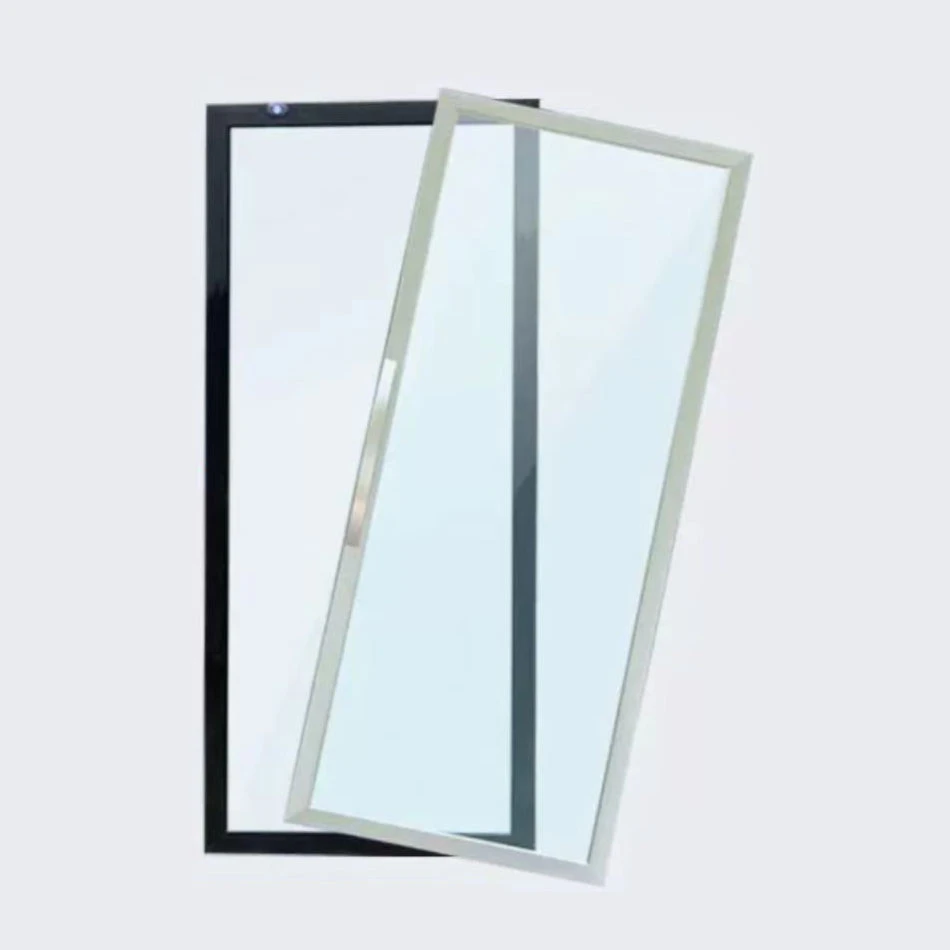
Convection tempering matters for coated and printed glass, because radiant furnaces heat the coated side unevenly and produce warpage that only appears after lamination or IG assembly. Ask which furnace a specific order will run on, not which furnace exists.
Request the fragment test result for the last three production lots of similar thickness: EN 12150 requires at least 40 particles in a 50 × 50 mm area, with no fragment exceeding the standard's limits. Bow should be within 3 mm per metre. For doors exposed to thermal stress — heated ITO doors, dark spandrel panels, roofs — ask whether heat-soak testing to EN 14179 is available and whether it is applied to the whole lot or sampled.
"Show me the furnace load record for the lot you shipped last month." A plant that tempers its own glass can trace a delivery back to a load number, a date and a shift. A plant that buys tempered glass from a partner usually cannot.
Most field failures of freezer door IG units are edge-seal failures, not glass failures. On the audit, follow one unit from spacer application to secondary sealing and check three things: whether the primary seal is applied by robot or hand, whether the secondary seal is polysulfide or silicone, and whether the desiccant is filled before or after spacer assembly.
Dew point is the only cheap proxy for all of it. EN 1279-2 testing should show −40 °C or lower at delivery. Ask for the desiccant lot and the batch record; a supplier who cannot name the desiccant grade is buying the cheapest available.

Curved capability is easiest to fake, because a bent sample can be bought in. Count the molds in the rack and look at their condition: a plant with 30 molds covering R300 to R2000 has a real bending program; a plant with three molds and a subcontractor does not.
Then measure. Bring a paper template or a chord-height gauge and check a finished piece against your drawing — chord height within ±1 mm and diagonal twist under 2 mm are reasonable expectations for display cabinet radii. Hold the piece against a grid or a straight edge under glancing light: visible waviness on a curved surface is far more objectionable to shoppers than the same distortion on flat glass.
If your project includes heated glass, this is the single most important audit point. Ask to see the coating line, the sheet resistance meter and a recent measurement log. Typical ITO films for defog applications run in a defined resistance range, and the number should be recorded per batch — not quoted as a catalogue figure.
If coating is subcontracted, the risk shifts to handling: coated glass must be bent and tempered after coating, and every extra transport step adds scratch and pinhole risk. Ask who bears the scrap rate on coated sheets, and at which stage the coating is inspected.
Ceramic ink fired into the glass surface is permanent; organic ink is not, and the difference is invisible in a sample photo. Confirm the ink type, the firing curve, and whether printing happens before tempering so the ink sinters with the glass.
Colour control is where brand-owned doors fail quietly. Ask for the ΔE value the plant holds in production, not the value in the specification, and request the spectrophotometer reading for the last batch of your colour. Registration tolerance for multi-colour logos should be stated numerically, and adhesion should be verified by a cross-hatch test on a fired sample.
An instrument on a shelf proves nothing; a log proves practice. Ask for the last three months of inspection records for one comparable SKU and look for entries that were corrected rather than entries that are uniformly perfect. Real records contain deviations.
Minimum instrument set for this product family: dew point meter, infrared camera for heated glass uniformity, polariscope or stress viewer, thickness and edge-chip gauges, and a transmission meter if Low-E or tinted glass is involved. The table below condenses the eight audit areas into what to physically see and the answer that should end the conversation.
| Audit area | What to see on site | Red flag |
|---|---|---|
| Process routing | Routing sheet matching the actual floor sequence | Steps listed but performed by a third party |
| Tempering | Convection furnace, fragment test log, load numbers | Furnace size below the quoted door size |
| Insulated glass | Robot primary seal, named desiccant, dew point −40 °C | "Sealed by hand, same result" with no data |
| Curved glass | Mold rack covering your radius, chord gauge in use | Samples only, no molds, no measuring tools |
| ITO coating | Coating line, resistance meter, per-batch log | Resistance quoted as a single catalogue value |
| Printing | Ceramic ink, firing before tempering, ΔE records | Organic ink, no spectrophotometer reading |
| QC records | Three months of logs with visible corrections | Perfect records, no deviations, no dates |
| Export readiness | Vertical crates, loading photos, certificate scope | ISO certificate covering a different product scope |
Export packaging is part of manufacturing capability, not logistics. Ask to see a packed crate opened at the top: vertical orientation, interlayer foam, corner protection and a fixed batten. Then ask for loading photos from the last container — a plant that photographs its own loading has a process; a plant that promises "professional packing" has a phrase.
Finally, read the certificates rather than count them. ISO 9001 scope should cover glass processing, not trading; CCC applies to the safety glass categories actually shipped; a third-party EN 12150 or ANSI Z97.1 report should name the glass thickness and the test laboratory. Certificates that list a scope wider than the plant's equipment are a warning sign in themselves.
Q: How long does a proper factory audit take?
A: One full day for a single product family. Half a day is enough for a trading company check, but tempering records, IG line observation and a curved-glass measurement together need most of a working day, plus an hour for document review.
Q: Can the audit be done remotely?
A: Partly. Video walk-throughs work for layout and equipment, and document requests work for records. Measurement of chord height, edge quality and optical distortion does not transfer to video — those need a physical sample sent to you or a third-party inspector.
Q: What should I audit first if time is limited?
A: The tempering load record and the IG dew point data. Those two answers reveal whether the plant owns its critical processes, and they take twenty minutes to verify.
An audit produces evidence, not a decision. Convert each verified point into a line in the purchase specification — furnace type, dew point limit, chord-height tolerance, ΔE value, crate design — so that the next batch is checked against the same numbers rather than against memory. Buyers who document the audit usually find the second order goes faster than the first.
Planning a supplier audit or a first order? Send your door drawings, glass build-up and annual volume to our engineering team for a DFM review and sample quotation, and we will return the process route, inspection plan and packaging proposal for your own checklist.
Further reading: Manufacturing capability · Client cases · Featured projects
Add:No. 16 Xingye Road, Beijiao Town Industrial Park, Shunde District, Foshan City, Guangdong Province
PHONE: +86 13509957538
TEL: +86 0757-26131933
Email: huayin_glass@163.com

© 2026 Huayin Glass Solutions All Rights Reserved.


