


 Add:No. 16 Xingye Road, Beijiao Town Industrial Park, Shunde District, Foshan City, Guangdong Province
 PHONE: +86 13509957538
 TEL: +86 0757-26131933
 Email: huayin_glass@163.com

Chinese


Curved tempered glass is a panel that is heated above its transition temperature, formed over a mold into a defined curvature, and then rapidly quenched to lock a compressed surface layer into the glass. In commercial refrigeration, it is the structural format behind nearly every non-rectangular freezer and display-cabinet door. This brief explains how multi-curvature panels are produced, which tolerances matter at order stage, and how bending combines with insulated and heating functions.
A single-curvature panel bends around one axis and behaves like a cylinder segment. Multi-curvature panels combine two or more radii, or blend a radius with corner treatments, matching cabinet designs where the glass wraps a rounded chassis.
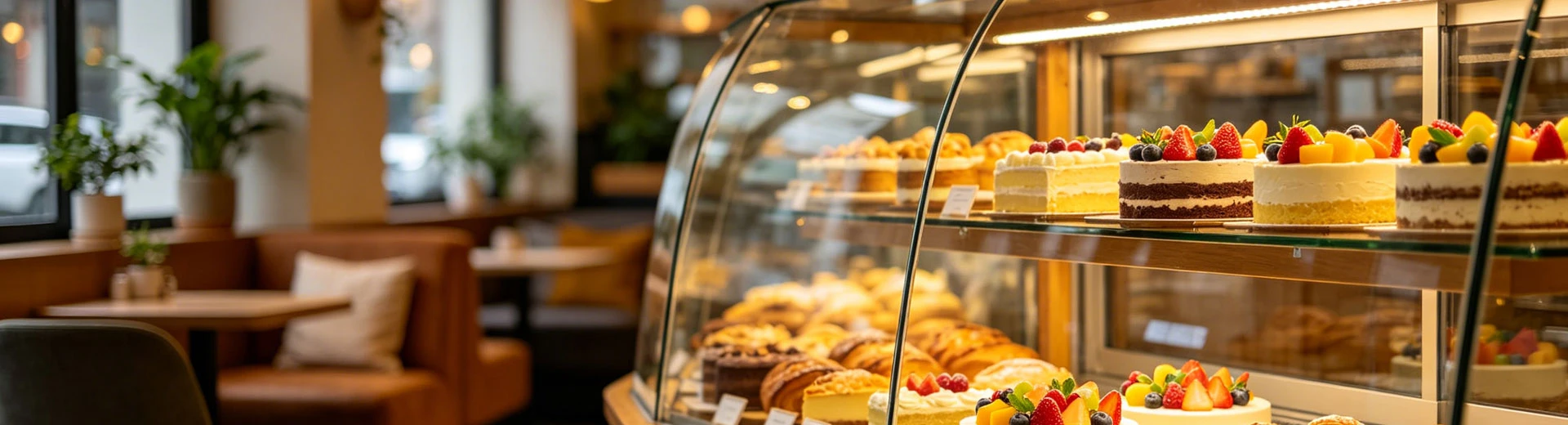
Pastry display cases, beverage coolers with wrap-around corners, and premium beer-cooler cabinets are the typical users. The more complex the geometry, the more the tooling and acceptance criteria must be fixed before production starts, not after the first sample arrives.
Flat glass cannot follow a rounded cabinet wall, and untempered bent glass cannot survive transport and daily handling in retail. Curved tempered glass exists precisely to combine both: geometry plus a safety-grade strength profile.
Cut-to-size panels are heated in a bending furnace and sagged or pressed over a stainless mold. Mold accuracy defines the curvature, so molds are validated against a 1:1 template before production. For small batches, an existing mold from the factory library can replace a new build entirely.
The formed panel passes into the quench while still hot. Forming and strengthening in one continuous cycle is what separates curved tempered glass from simple hot bending, which shapes the glass but leaves it unstrengthened. Skipping the tempering stage is the most common cause of breakage claims on imported curved doors.
Glass tends to return toward flat after forming; the mold compensates by over-bending. Controlling spring-back across a production run, rather than on a single sample, is the main process skill in curved work and the reason supplier experience matters more for bent panels than for flat ones.
| Parameter | Typical practice | Verification |
|---|---|---|
| Radius / rise | Confirmed against chord and rise, or a 1:1 template | Template fit check at incoming inspection |
| Curvature-to-template gap | Within about 1 mm on the curved edge | Feeler gauge against template |
| Chord length | Standard cutting tolerance, around ±1 mm | Caliper or gauge |
| Twist | Not visually detectable when placed flat | Flat-surface check |
| Edge work | Ground and polished before bending | Visual, no chips after forming |
Quench transport can leave faint periodic waviness on the surface. On display doors it matters, because store lighting amplifies reflections. Acceptance is usually defined by viewing the panel at an angle against a straight reference line, with limits agreed before mass production.
Tempered glass shows stress birefringence; curved parts can display more visible iridescence under polarized light. Anisotropy is inherent to the process rather than a defect, but its acceptable level should be written into the specification to avoid end-of-line disputes. Retail display projects typically agree on a viewing condition and a sample panel as the reference standard.
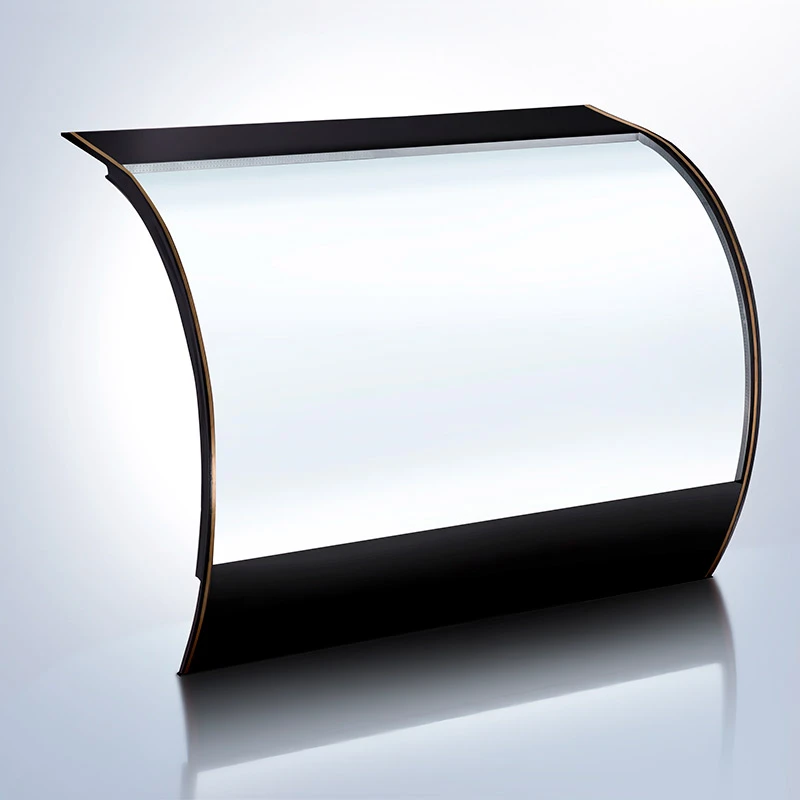
A curved tempered pane can be assembled into an insulated glass unit with a matching bent outer lite, spacer and desiccant fill. This gives the door both its geometry and its thermal performance, and is the standard format for pastry display cabinet glass and curved beverage coolers.
For high-humidity markets, a transparent conductive coating can be deposited before bending and tempering, producing a door that holds its outer surface above the dew point. The coating sequence must be planned with the bending cycle, which is why coated curved tempered heated IG glass should be sourced from a factory that runs coating, bending and insulated assembly on one site.
| Item | Typical range | Notes |
|---|---|---|
| Glass thickness | 4-6 mm common for door lites | Thicker panels reviewed per drawing |
| Curvature radius | R300-R2000 mm customary in the industry | Outside range needs feasibility review |
| Configurations | Single lite, insulated, coated heated, laminated | See the thermally bent glass series |
| Safety standards | GB 15763.2, EN 12150, ANSI Z97.1 as applicable | Matched to destination market |
| Panel size | Within furnace loading limits | Confirm largest panel with the factory |
Values above are industry-typical rather than fixed promises; each factory's tempering furnace and mold library define the real envelope. Asking for the envelope early filters out suppliers who would discover limits at tooling stage.
| Term | Definition |
|---|---|
| Multi-curvature | Geometry combining two or more radii, or radius plus corner treatment, in one panel |
| Chord and rise | Straight width of the curved panel, and the height of the arc above the chord, used to define curvature |
| Spring-back | Tendency of hot glass to relax toward flat after forming, compensated by over-bending on the mold |
| Roll wave | Faint periodic surface waviness that can appear during quench transport |
| Anisotropy | Stress birefringence visible as iridescence under polarized light, inherent to tempering |
| IGU | Insulated glass unit; two or more panes sealed with a spacer and dry gas or air fill |
Q: What information is needed to quote a curved freezer door?
A: Chord and rise (or a 1:1 template), thickness, configuration — single, insulated or coated heated — and annual quantities. With those four items an engineering team can return a manufacturability assessment quickly.
Q: Can a supplier reuse an existing curvature mold?
A: Often yes. Asking whether the radius already exists in the supplier's mold library reduces tooling cost and shortens lead time; new radii require a mold build that is quoted separately.
Huayin Glass Solutions produces curved tempered, bent insulated and coated heated panels in a 6,000+ square meter facility in Foshan, Guangdong, alongside commercial supermarket freezer glass and wine cooler cabinet glass. Bending, tempering, coating and insulated assembly are handled on one production site, which keeps the process sequence under single-point quality control; project references are available on the featured projects page.
Send your chord, rise and configuration for a feasibility review: contact our engineering team.
Further reading: Hot bent insulated heating glass · Manufacturing capability · Products overview
Add:No. 16 Xingye Road, Beijiao Town Industrial Park, Shunde District, Foshan City, Guangdong Province
PHONE: +86 13509957538
TEL: +86 0757-26131933
Email: huayin_glass@163.com

© 2026 Huayin Glass Solutions All Rights Reserved.


